Vector Engine Introduction
Access the Performance Benchmark
Accelerate Your Motor Control with Vector Engine
Unlock faster BLDC control with Toshiba’s TXZ+ MCUs and Vector Engine — watch the demo and download slides..
Access the Performance Benchmark
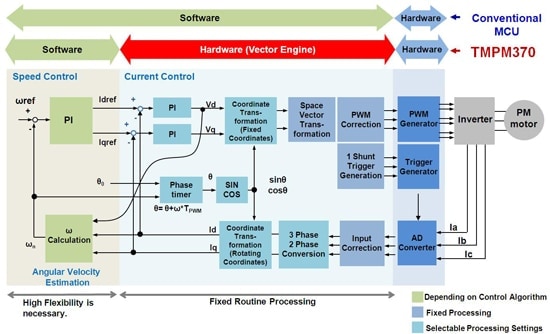
Why Software-Only FoC Hits CPU Limits
Conventional MCUs spend cycles on complex trigonometric transforms and control loops, which leads to high CPU load, limited PWM frequency, and reduced responsiveness.
Simplify FoC Design with Hardware-Based Vector Engine
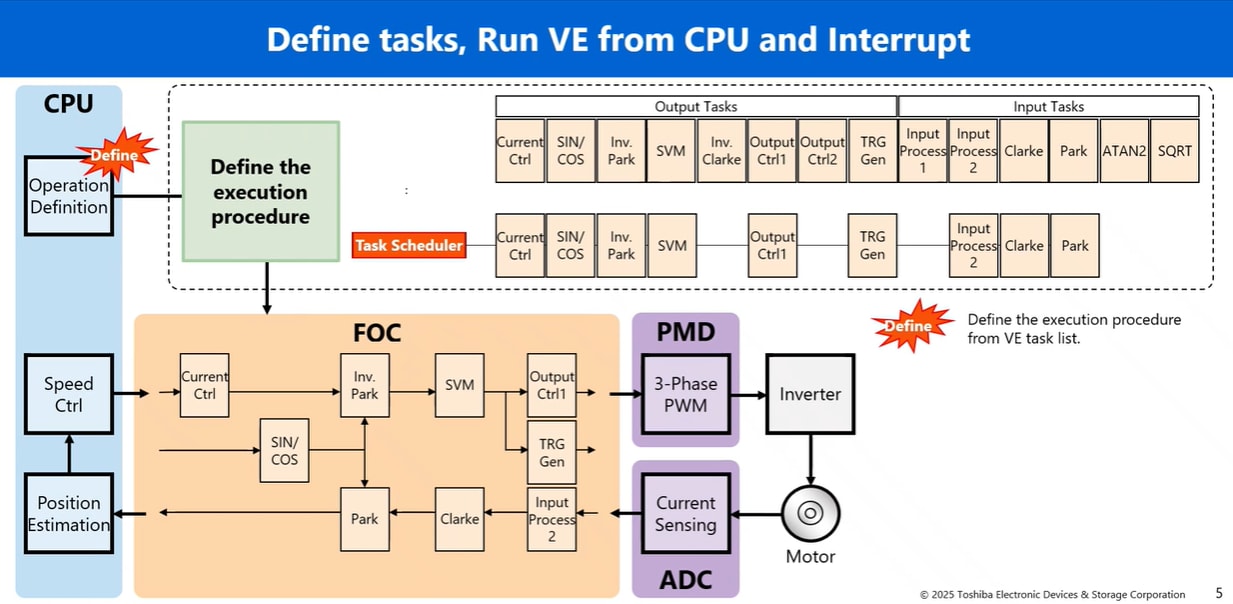
Toshiba's Vector Engine executes FoC tasks directly in hardware, freeing CPU resources for application logic and networking. This simplifies design while ensuring high responsiveness and predictable performance.
Faster PWM Updates. Lower CPU Load. Measurable Gains
In testing, TXZ+ MCUs with Vector Engine achieved up to 40% CPU load reduction while maintaining 20 kHz PWM, with measurable gains of up to 30% efficiency in BLDC motor applications.
FOC Hardware Offload Explained:
Performance, CPU Savings, and When to Use Vector Engine
See how hardware-based FOC acceleration is implemented in Vector Engine MCUs — and how it integrates into real-world motor control architectures.

→ Includes a real-world FOC workload comparison showing
which control functions are best offloaded to hardware.
→ Watch full 8:47 presentation after submitting form
Why Watch This Video
Compare MCU-only vs MCU + Vector Engine architectures to determine when FOC workloads should be offloaded to hardware.See a detailed comparison of MCU-only vs MCU + Vector Engine architectures, showing how Field-Oriented Control (FOC) workloads are offloaded to hardware to reduce CPU load and improve 3-phase BLDC control performance.
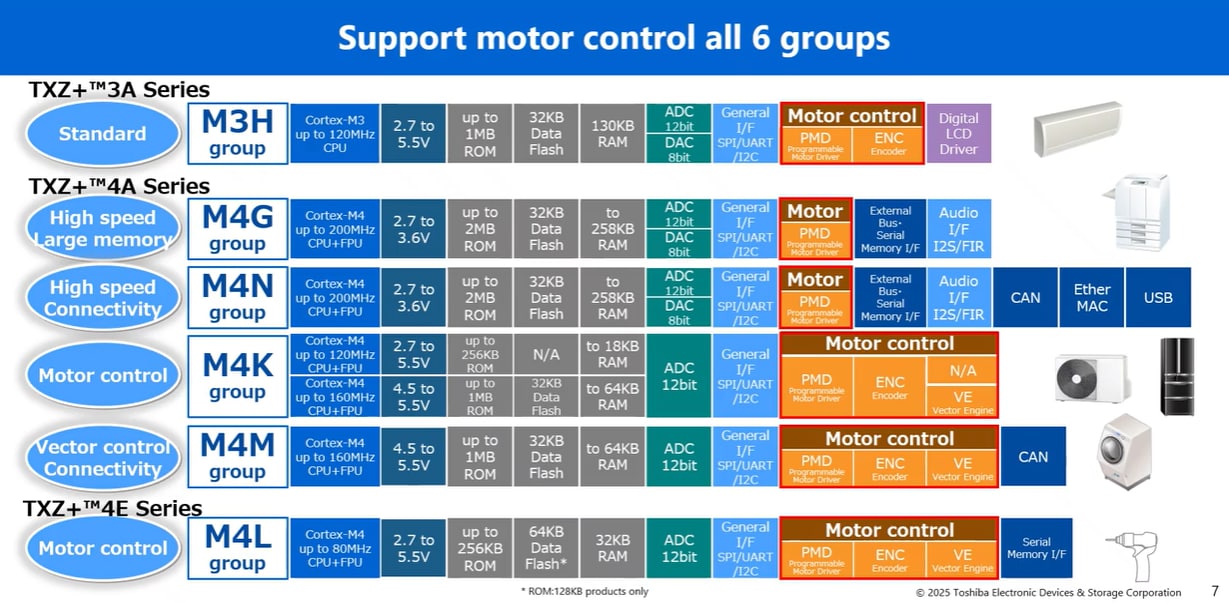
Supported MCU Families

M4K
Motor Control Optimized
- High performance + motor-centric hardware offload
- Memory capacity & firmware resilience
- Rich peripheral and analog interface
- Functional safety, broad operating range & flexibility

M4G
General-Purpose + VE
- High performance Arm Cortex-M4 + FPU, up to ~200 MHz
- Large memory and data-flash with high write endurance
- Rich set of connectivity and enhanced anolog/sensor support
- Self-diagnosis & safety-minded design

M4N
Networking + Control
- High performance Arm Cortex-M4 core FPU, up to 200 MHz
- Large code flash + data flash with high write-cycle endurance
- Rich connectivity, Ethernet, USB OTG, CAN, serial interfaces, and DMAC
- Self-diagnosis & functional safety support (IEC60730 Class B)