Vector Engine Introduction
Access the Performance Benchmark
Vector Engine Introduction
See how Toshiba’s Vector Engine–equipped MCUs can help make Field Oriented Control (FOC) 3-phase Brushless DC motor designs more efficient.
Access the Performance Benchmark
Vector Engine offloads CPU FoC workloads
Hardware implementation frees the CPU for efficiency.
Flexible implementation
Target specific BLDC motor and system requirements.
CPU time for other tasks
Free cycles for communications, sensors, and AI tasks.
FOC Hardware Offload Explained:
Performance, CPU Savings, and When to Use Vector Engine
See how hardware-based FOC acceleration is implemented in Vector Engine MCUs — and how it integrates into real-world motor control architectures.

→ Includes a real-world FOC workload comparison showing
which control functions are best offloaded to hardware.
→ Watch full 8:47 presentation after submitting form
Why Watch This Video
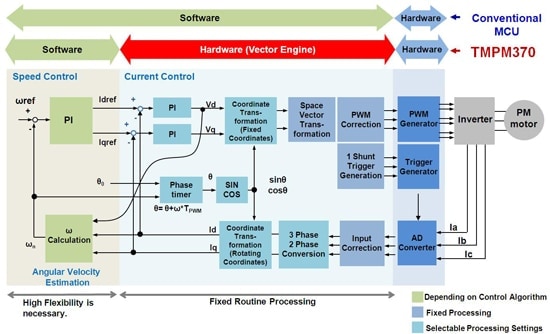
Compare MCU-only vs MCU + Vector Engine architectures to determine when FOC workloads should be offloaded to hardware.See a detailed comparison of MCU-only vs MCU + Vector Engine architectures, showing how Field-Oriented Control (FOC) workloads are offloaded to hardware to reduce CPU load and improve 3-phase BLDC control performance.
Vector Engine Technical Presentation
- How FoC vector calculations are implemented in BLDC control systems.
- How some FoC operations can be scheduled and implemented in Vector Engine hardware for better efficiency.
- Comparative performance example of MCU only vs. MCU plus Vector Engine FoC implementations.
- Toshiba TXZ+ MCU family lineup that includes Vector Engine.