

Toshiba Starts Mass Production of Compact Microcontrollers with Arm® Cortex®-M4 Core for Single-Motor Control Applications
July 30, 2026
Toshiba Electronic Devices & Storage Corporation
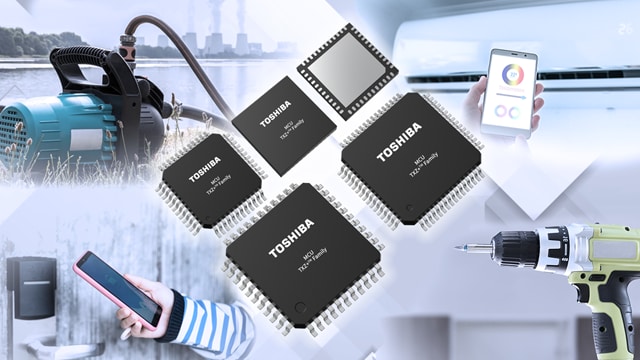
KAWASAKI, Japan—Toshiba Electronic Devices & Storage Corporation ("Toshiba") has started mass production of TXZ+™ Family Entry‑Class M4L Group, compact microcontrollers featuring an Arm® Cortex®‑M4 core with a floating‑point unit (FPU) for next-generation home appliances, consumer products and industrial equipment.
Demand is growing for energy efficiency, compact designs, IoT connectivity, and enhanced maintainability in home appliances, consumer products and industrial equipment. This requires motor-control microcontrollers that add functions for improved development efficiency and system reliability alongside high-precision control.
Toshiba’s new products are compact microcontrollers specifically designed for single-motor control applications that integrate dedicated motor-control hardware[1], security functions, and functional safety measures on a single chip. By offloading motor-control processing to dedicated hardware, they reduce the CPU load, enabling highly efficient and precise motor control.
The microcontrollers are built around an Arm® Cortex®‑M4 core with FPU and operate at frequencies up to 80MHz. They support a supply voltage range of 2.7V to 5.5V, delivering compatibility with existing 3V‑ and 5V‑based systems while bringing high design flexibility to new designs. They are available in four types of small package with 44 to 64 pins and two different memory configurations, allowing selection according to application requirements. Integration of a high‑speed oscillator with ±1% accuracy[2] and an overcurrent detection comparator for emergency motor shutdown reduces external components and helps minimize board area. In addition, a low‑power STOP2 mode supports battery‑powered applications.
The 256KB products[3] adopt dual‑bank flash memory with two 128KB blocks, allowing one program to be executed while the other area is rewritten. This secures program updates without stopping system operation and facilitates implementation of firmware over-the-air updates. The 128KB products[4] incorporate 64KB of data flash memory to support storage of log data and management of configuration information.
For security, the microcontrollers integrate chip protection (CPRO), secure access memory (SAM), and non‑rewritable flash protection (NRFP). These functions help prevent unauthorized access, control memory access, and protect critical areas, thereby improving system reliability across a wide range of applications, including IoT devices.
The microcontrollers also integrate general‑purpose communications interfaces, such as universal asynchronous receiver/transmitter (UART), a serial peripheral interface (SPI), an inter‑integrated circuit[5], and a serial memory interface (SMIF) for external memory connectivity. Functional safety measures include abnormality detection covering flash memory, RAM, analog‑to‑digital converters and clock systems. Toshiba also provides certified software compliant with UL 60730 Class B, a functional safety standard for household appliances, helping customers streamline their certification processes.
Toshiba supports evaluation and development with product documentation, sample software, and driver software for peripheral control. The company will also roll out evaluation boards and various development environments in collaboration with Arm® ecosystem partners, supporting customers from initial adoption through mass production.
Toshiba will continue to expand its lineup of microcontrollers optimized for motor control applications and strengthen development support, contributing to acceleration of customers’ product development.
Notes:
[1] Advanced Vector Engine 2 (A‑VE2): Performs vector control calculations in hardware at high speed.
Advanced Programmable Motor Control Circuit 2 (A‑PMD2): Controls PWM output and motor drive operation.
Advanced Encoder Input Circuit 2 (A‑ENC2): Detects encoder signals and obtains rotational position and speed.
[2] Conditions for ±1% accuracy:
Supply voltage: 2.7V to 5.5V, temperature: −40 to 105°C.
[3] TMPM4L4FYAUG, TMPM4L2FYADUG, TMPM4L2FYAQG, TMPM4L1FYAUG
[4] TMPM4L4FWAUG, TMPM4L2FWADUG, TMPM4L2FWAQG, TMPM4L1FWAUG
[5] Inter‑Integrated Circuit: A serial communication standard for short‑distance, low‑speed communication between ICs.
Applications
- Next-generation home appliances and consumer equipment, including smart appliances and devices with IoT functionality
- Industrial equipment and factory automation (FA) systems
- Office and commercial equipment
Features
- Arm® Cortex®‑M4 core with FPU: operating 80MHz (max)
- Dedicated motor-control hardware
- Security functions
- Firmware updates during operation (256KB code flash products only, dual‑bank flash)
- Self-diagnosis functions for functional safety
- Supply voltage range: 2.7V to 5.5V
- Internal memory
Code flash memory: 128 KB, 256KB
Data flash memory: 64KB (128KB code flash products only)
RAM: 32KB
VE RAM: 4KB - Four types of small package with 44 to 64 pins (LQFP/VQFN)
Main Specifications
| Product group | M4L Group | ||||
|---|---|---|---|---|---|
| Part number[6] | TMPM4L4FYAUG TMPM4L4FWAUG |
TMPM4L2FYADUG TMPM4L2FWADUG |
TMPM4L2FYAQG TMPM4L2FWAQG |
TMPM4L1FYAUG TMPM4L1FWAUG |
|
| CPU core | Arm® Cortex®-M4 core with FPU - Memory protection unit (MPU) |
||||
| Maximum operating frequency | 80MHz | ||||
| Internal oscillator |
Oscillation frequency |
10MHz (±1%) | |||
| Internal memory |
Flash (code) (Program/erase cycles: up to 100,000 times) |
256KB/128KB | |||
| Flash (data) | 64KB[7] | ||||
| RAM | 32KB, with parity | ||||
| VE RAM | 4KB | ||||
| I/O port | 51 pins | 35 pins | 31 pins | ||
| External interrupt | 21 factors, 21 pins | 13 factors, 13 pins | 9 factors, 9 pins | ||
| DMA controller (DMAC) | 32 channels | 30 channels | 28 channels | ||
| Timer function |
32-bit timer event counter (T32A) |
5 channels (10 channels if used as 16-bit timer) |
|||
| Communication function |
UART | 6 channels | 5 channels | 4 channels | |
| I2C interface version A (EI2C) |
2 channels | 1 channel | |||
| TSPI | 3 channels | 2 channels | |||
| SMIF | 1 channel | ||||
| Analog function |
12-bit AD converter (ADC) |
14inputs in 2 units | 9 inputs in 2 units | 8 inputs in 2 units | |
| 8-bit DA converter (DAC) |
2 channels | ||||
| Comparator (COMP) |
6 channels | ||||
| Motor control circuit |
Advanced programmable motor control circuit 2 (A-PMD2) |
1 channel | |||
| Advanced encoder input circuit 2 (A-ENC2) |
1 channel | ||||
| Advanced vector engine 2 (A-VE2) |
1 channel | ||||
| Other | CRC calculation circuit (CRC) |
1 channel (CRC32, CRC16) | |||
| System function |
Watchdog timer (SIWDT) |
1 channel | |||
| Voltage detection circuit (LVD) |
1 channel | ||||
| Oscillation frequency detector (OFD) |
1 channel | ||||
| Security function | Chip Protection (CPRO), Secure Access Memory (SAM), Non‑Rewritable Flash Protection (NRFP) |
||||
| Debug interface | JTAG / SW TRACE(2bits) |
JTAG/SW | |||
| Operating voltage | 2.7V to 5.5V, single voltage supply | ||||
| Package/Pin | LQFP64 (10mm×10mm, 0.5mm pitch) |
LQFP48 (7mm×7mm, 0.5mm pitch) |
VQFN48 (7mm×7mm, 0.5mm pitch) |
LQFP44 (10mm×10mm, 0.8mm pitch) |
|
Notes:
[6] "FY" in the part number indicates 256KB of code flash memory and "FW" indicates 128KB.
[7] 128KB code flash products[4] only.
Follow the link below for more on the M4L Group.
M4L Group
Follow the link below for more on Toshiba’s Microcontrollers.
Microcontrollers
Customer Inquiries:
MCU & Digital Device Sales & Marketing Dept.
Tel: +81-44-548-2233
* Arm and Cortex are registered trademarks of Arm Limited (or its subsidiaries) in the US and/or elsewhere.
* TXZ+™ is a trademark of Toshiba Electronic Devices & Storage Corporation.
* Other company names, product names, and service names may be trademarks of their respective companies.
* Information in this document, including product prices and specifications, content of services and contact information, is current on the date of the announcement but is subject to change without prior notice.