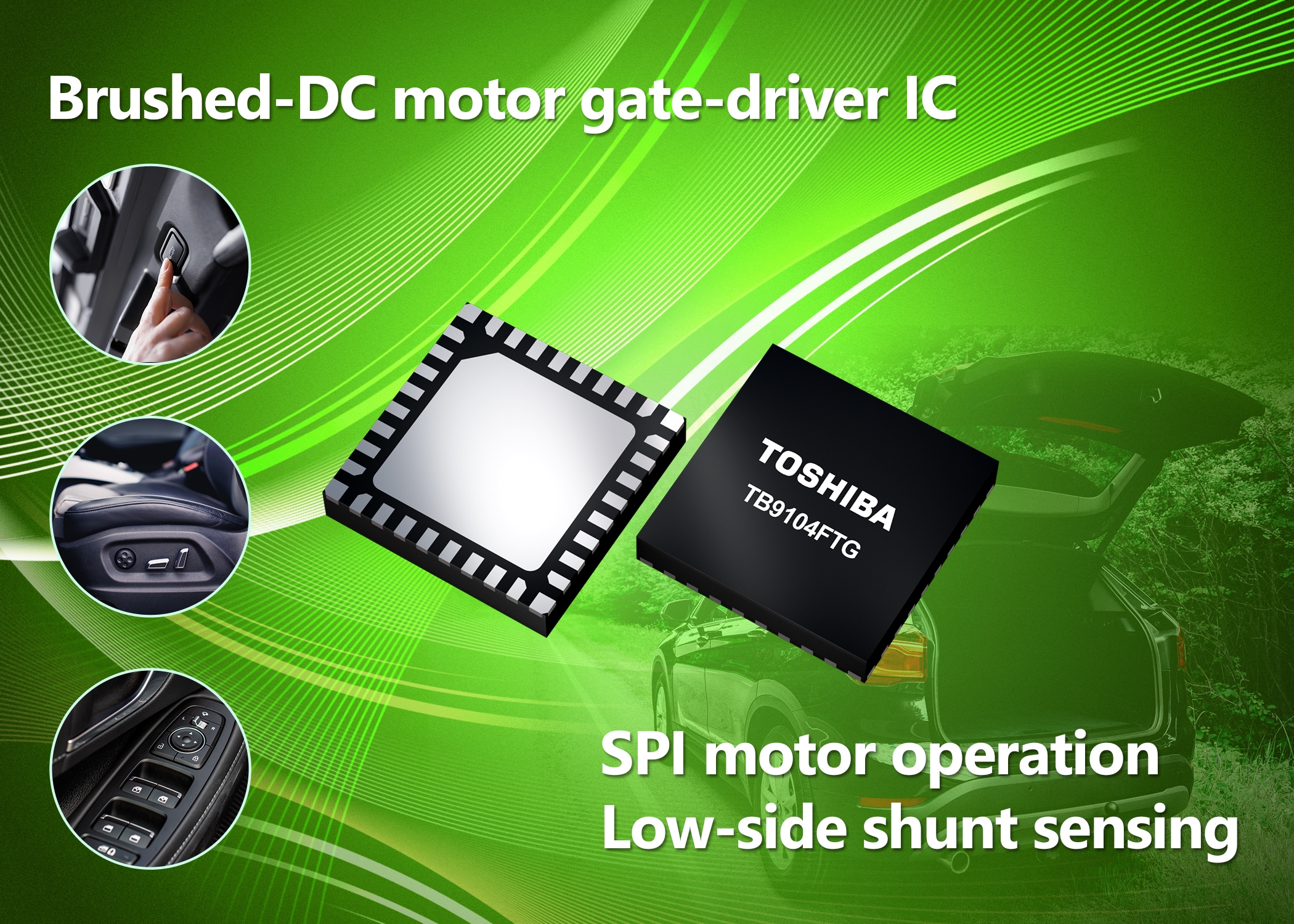
Toshiba sampling gate driver IC for automotive brushed DC motors
29th January 2026
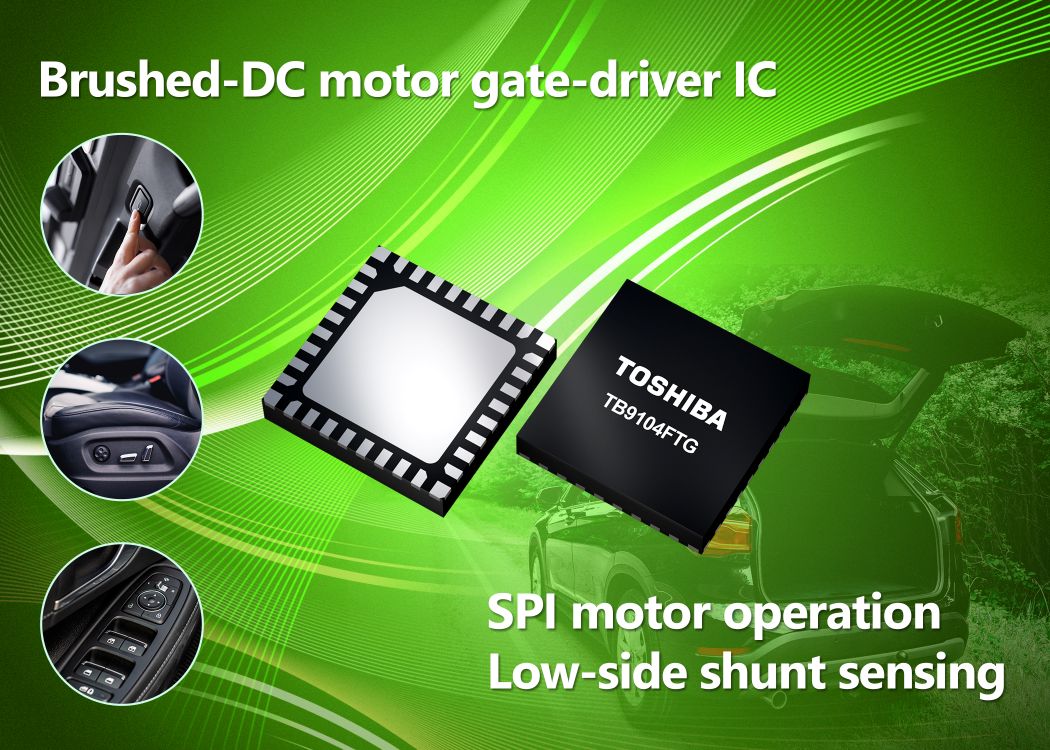
Düsseldorf, Germany, 29th January 2026 – Toshiba Electronics Europe GmbH (“Toshiba”) announces shipment of engineering samples for the TB9104FTG, a gate driver IC designed to control high-current brushed DC motors. Applications include powered tailgates, sliding doors and seat adjusters.
In addition to the optionally available standard PWM input pins, the new gate driver IC features an intelligent serial peripheral interface (SPI) for controlling the motor operation itself.
Several motors can be controlled using just the SPI bus. Thus the TB9104FTG significantly streamlines system architecture, reducing wiring harness and the MCU processing load with its built-in PWM clock-generation circuits. By using the SPI, the host microcontroller (MCU) can have fewer pins and initiate motor drive with a single SPI rotation command, reducing MCU processing load and preventing communication bus congestion.
These capabilities are housed in a compact VQFN32 package measuring 5.0mm by 5.0mm (typ.), which features an exposed thermal pad to ensure effective heat dissipation when paired with external H-bridge MOSFETs. A dual half-bridge mode is also supported for operating two DC motors simultaneously. To address safety in high-current applications, the driver integrates a high-precision current-sense amplifier that provides feedback to the MCU, enabling precise drive-stop control during abnormal current events. The device also includes detection functions for low voltage, charge-pump overvoltage, overheating, external MOSFET monitoring, and SPI errors.
Scheduled for AEC-Q100 (Grade 1) qualification, the device is designed to operate over -40°C to +125°C, supporting the safety and reliability requirements of next-generation automotive equipment.
Toshiba will continue to expand its lineup of driver ICs for automotive motors, contributing to the electrification and enhanced safety of body systems.