

Toshiba Launches Dual-Channel Standard Digital Isolators that Contribute to Lower Power Consumption in Industrial Equipment
October 1, 2026
Toshiba Electronic Devices & Storage Corporation
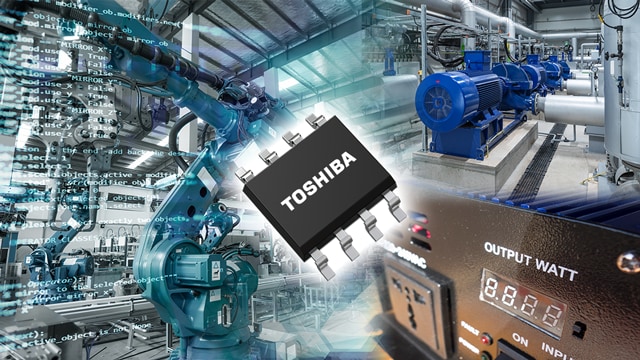
KAWASAKI, Japan—Toshiba Electronic Devices & Storage Corporation ("Toshiba") has launched four dual-channel standard digital isolators for industrial equipment, the "DCL32xx00 Series." The new products achieve low current consumption of 0.2mA per channel[1] (typ.), support mid-speed communications[2], and feature an SOIC8-N package. Volume shipments start today.
The lineup includes "DCL320C00" and "DCL320D00," configured with two forward channels, and "DCL321C00" and "DCL321D00," configured with one forward channel and one reverse channel. Following on from the release of DCL34xx0B Series of quad-channel standard digital isolators, the addition of these new products brings Toshiba’s lineup of low-power-consumption standard digital isolators for industrial equipment to ten products, including six in the DCL34xx0B Series. This expands channel-count options and contributes to improved design flexibility.
In industrial equipment, such as programmable logic controllers (PLCs), actuators and inverters, it is crucial to prevent equipment failures, the propagation of abnormalities, and malfunctions caused by noise, which increases with higher-speed device operation. All these issues are addressed by electrical isolation that transmits signals between circuits operating at different potentials, such as high and low voltage, which is driving demand for safe, highly reliable isolation devices that maintain stable operation in noisy environments. Alongside superior reliability, and as equipment continues to become more compact, isolation devices are also, more than ever, required to offer smaller sizes, plus a longer service life.
In addition, reducing overall system power consumption is at the heart of achieving carbon neutrality, and low-power operation has become an increasingly important requirement in electronics, including isolation devices.
All four new products use Toshiba’s proprietary magnetic coupling isolation transmission technology[3] to meet market requirements for high reliability and long service life. They also incorporate a new Toshiba circuit technology in the isolation signal transmission section that allows them to achieve low power consumption of 0.2mA per channel[1] (typ.) at 1Mbps, while supporting data transmission at speeds of up to 25Mbps (max). These characteristics contribute to stable equipment operation and lower power consumption.
The new products are rated for an isolation voltage of 3000Vrms (min) and operate over a wide temperature range of -40 to 125°C, and a wide supply voltage range of 2.25 to 5.5V.
The adoption of an industry-standard SOIC8-N package meets demand for more compact equipment designs.
DCL32xx00 Series products are suitable for I/O interface applications. The DCL320C00 and DCL320D00, configured with two channels, support unidirectional digital signal transmission, such as I2C communications[4]. DCL321C00 and DCL321D00, configured with one forward channel and one reverse channel, support bidirectional digital signal transmission, such as UART communications[5]. This enables flexible product selection according to application requirements.
Toshiba offers "DCL54xx01A Series" and "DCL52xx00 Series" as standard digital isolators for industrial equipment supporting high‑speed data communications, and "DCM34xx01 Series" and "DCM32xx00 Series" as standard digital isolators for automotive applications, allowing customers to select products that meet application requirements.
Toshiba will contribute to the realization of carbon neutrality by continuing to expand its lineup of digital isolators for industrial and automotive equipment, broadening the channel count and package options, and pursuing performance improvements. Along with photocouplers that provide optical isolation, Toshiba will provide a lineup of high‑quality isolation devices that support stable operation in communications and control systems requiring electrical isolation.
Notes:
[1] Calculated using 1Mbps operating current value, derived from (IDD1+IDD2) divided by two channels.
Measurement conditions: VDD1=VDD2=3.3V, data transmission rate tbps=1Mbps, CL=15pF, Ta=25°C
[2] Communications speed range of up to 25Mbps
[3] A signal transmission method that integrates a modulation chip and a demodulation chip with insulation layers into a single package and uses a magnetic field to transmit signals.
[4] I2C (Inter-Integrated Circuit): synchronous serial communications. Communications method for transmitting and receiving data synchronized with a clock signal.
[5] UART (Universal Asynchronous Receiver Transmitter): asynchronous serial communications. A communications method for transmitting and receiving data without a clock signal.
Applications
- Industrial automation (programmable logic controllers (PLCs), I/O interfaces, etc.)
- Field devices (sensors, actuators, etc.)
- Motor control
- Inverters
- Switching power supply
Features
- Low operating current consumption: 0.2mA (typ.) per channel[1]
- Supports mid-speed data transmission: tbps=25Mbps (max)
- Wide operating temperature range: Topr=-40 to 125°C
- Dual-channel configuration:
Two forward channels and zero reverse channels (DCL320C00, DCL320D00)
One forward channel and one reverse channel (DCL321C00, DCL321D00) - SOIC8-N package
Main Specifications
| Part number | DCL320C00 | DCL320D00 | DCL321C00 | DCL321D00 | ||||
|---|---|---|---|---|---|---|---|---|
| Number of channels (Forward directions: reverse directions) | 2 (2:0) | 2 (2:0) | 2 (1:1) | 2 (1:1) | ||||
| Default output logic[6] | Low | High | Low | High | ||||
| Package |
Name | SOIC8-N(P-SOP8-0405-1.27-002) | ||||||
| Size (mm) | Typ. | 4.9×6.0×1.75 | ||||||
| Absolute maximum ratings | Operating temperature Topr (°C) | -40 to 125 | ||||||
| Storage temperature TSTG (°C) | -65 to 150 | |||||||
| Isolation voltage (60s) BVS (Vrms) | Ta=25°C |
Min | 3000 | |||||
| Recommended operating conditions | Power supply voltage VDD1 (V) | Topr=-40 to 125°C | 2.25 to 5.5 | |||||
| Power supply voltage VDD2 (V) | 2.25 to 5.5 | |||||||
| Electrical characteristics | 1Mbps operating current | Primary-side supply current IDD1(1) (μA) | VDD1=VDD2=3.3V, fCLK=500kHz, duty=50% cycle square wave, CL=15pF, Ta=25°C | Typ. | 160 | 160 | 215 | 215 |
| Secondary-side supply current IDD2(1) (μA) | 260 | 260 | 215 | 215 | ||||
| 25Mbps operating current | Primary-side supply current IDD1(25) (mA) | VDD1=VDD2=3.3V, fCLK=12.5MHz, duty=50% cycle square wave, CL=15pF, Ta=25°C | Typ. | 3.4 | 3.4 | 3.2 | 3.2 | |
| Secondary-side supply current IDD2(25) (mA) | 2.8 | 2.8 | 3.2 | 3.2 | ||||
| Data rate tbps (Mbps) | VDD1=VDD2=2.25 to 5.5V, Ta=-40 to 125°C | Max | 25 | 25 | 25 | 25 | ||
| Propagation delay tPHL, tPLH (ns) | VDD1=VDD2=3.3V, 50kHz, Duty=50%, tr=tf=2ns, CL=15pF, Ta=-40 to 125°C | Max | 52 | 52 | 52 | 52 | ||
| Common mode transient Immunity |CMTI| (kV/μs) | VDD1=VDD2=3.3V, VI=VDDI[7] or 0V, VCM=400V, Ta=25°C | Min | 30 | 30 | 30 | 30 | ||
| Sample check & availability |  |
|
|
|
||||
Notes:
[6] Default output logic indicates which logic level the output pin of a digital isolator holds as its initial state when the input signal is undefined, such as immediately after power‑on or when the input is floating.
[7] VDDI refers to the input-side VDD1 or VDD2
Follow the links below for more on the new products.
DCL320C00
DCL320D00
DCL321C00
DCL321D00
Follow the link below for more on Toshiba’s Isolators/Solid State Relays.
Isolators/Solid State Relays
To check availability of the new products at online distributors, visit:
DCL320C00
DCL320D00
DCL321C00
DCL321D00
Customer Inquiries:
Optoelectronic Device Sales & Marketing Dept.
Tel: +81-44-548-2218
* Company names, product names, and service names may be trademarks of their respective companies.
* Other company names, product names, and service names may be trademarks of their respective companies.
Information in this press release, including product pricing and specifications, content of services and contact information, is current and believed to be accurate on the date of the announcement, but is subject to change without prior notice. Technical and application information contained here is subject to the most recent applicable Toshiba product specifications.