PCIM 2026
Technology · Quality · Sustainability
Join Toshiba Electronics Europe at PCIM 2026 as we advance the journey toward an all‑electric society. With highly efficient power semiconductors and solutions, we push performance, reliability and sustainability forward. Bookmark this page to stay updated and meet us in Hall 4A‑227.
Your Team Toshiba
Committed to People. Committed to the future.
Portfolio News
-
01
-
02
-
03
-
04
-
05
-
06
-
07
Power Semiconductors
Speakers at PCIM
Wednesday, 10 June 2026
Exhibitor Stage, Hall 4A, 320
15:50 - Increasing the density of power supplies for AI server or charger with SMD SiC MOSFETs
There is a growing need for dense, high-power conversion systems across a variety of applications, from AI server to transportation. Conventional packaging, such as TO-247-3/4 offers good cooling performance, but it has limitations in terms of design flexibility. A shift to surface-mount packaging, enabled by the high efficiency of SiC, provides extra dimensions for design optimization. The transfer of key elements of the power converter onto vertically mounted daughter cards allow for higher density. A special emphasis will be placed on the thermal optimization of these daughter cards to reduce the temperature increase of the SiC MOSFETS under heavy load.
About the author: Dr. Matthias Ortmann joined Toshiba Electronics Europe 20 years ago. During this time, he gained vast experience in application engineering and supporting various product families under the Toshiba brand including optical devices, discrete MOS and SiC FETs, SiC modules, instrument cluster devices, ADAS, audio amplifier and interface devices. Before he joined Toshiba, Dr. Ortmann worked at Behringer – Special Studio Equipment as Hardware Developer and Supervisor Hardware Engineering.
Thursday, 11 June 2026
Stage: Istanbul, Level 2 IGBT Technologies
10:10 - 6500 V-Class PPI Using 2nd Generation Trench-IEGTs
A new 6500 V / 2000 A Press Pack IEGT (PPI) using 2nd generation trench-IEGT chips has been developed. These chips feature a shorted dummy-cell structure that ensures excellent RBSOA and short-circuit capability. To exceed 6500 V breakdown voltage, a guard ring termination and optimized interface process between the semi-insulating layer and silicon substrate were introduced. This design suppresses voltage variation during bias testing, enabling reliable 6500 V-class operation.
Co-Authors: Kazushi Maeda, Daiki Watanabe, Keigo Yoshida, Raita Kotani, Akiyo Kawakami, Ryota Kiya, Hideaki Kitazawa, Takeshi Suwa, Naoto Tsukamoto, Shigeaki Hayase, Toshiba, JP
About the author: Ryohei Gejo is an expert at Toshiba Electronic Devices & Storage Corporation, specializing in power semiconductor device design. He has been engaged in the development of bipolar devices, particularly IEGTs, for many years. His work focuses on trench structures, termination design, and improving device reliability for high-voltage applications. He has contributed to multiple generations of IEGT technology and has authored several technical papers in the field.
Thursday, 11 June 2026
Stage: St. Petersburg, Level 2 SiC MOSFETs II
15:00 - Efficient High-Frequency Inverter Operation of Power Module with Advanced SBD-Embedded SiC MOSFET
High-performance SBD-embedded SiC MOSFET chips enable reliable, efficient power modules. We achieved up to 37% lower on-resistance with 23% smaller chip size and improved diode reliability, allowing fewer chips and better switching. Optimized modules reduced turn-on loss by half and inverter energy loss by ~30% at 60 kHz, 150 °C. These advancements are crucial for next-generation power electronics.
Co-Authors: Shun Takeda, Haruhiko Miyagawa, Saho Fuji, Hiroyuki Irifune, Tomohiro Iguchi, Hiroshi Kono, Toshiba, JP
About the author: Shunsuke Asaba received a masters degree from Nagoya University, Japan in 2014. He joined Toshiba Corporation as a researcher and is involved in R&D of wide-bandgap semiconductor devices. In his current work on SiC-MOSFET, he studies device structure and MOS process technology.
You missed keynotes from recent PCIM? Click to catch up.
Impact of SBD embedding into SiC MOSFETs on dynamic behavior at High Temperature (Source: IEEE Xplore; you need to subscribe to download the paper)
Toshiba investigated the impact of integrating Schottky barrier diode (SBD) into silicon carbide MOSFET on their dynamic behavior at high temperatures. The team measured the diode characteristics without interference from the switching device. The findings indicate that SBD integration eliminates the temperature dependence of recovery characteristics and reduces diode recovery loss by 50% at a high temperature of 175deg C. Additionally, the team clarified that the reverse recovery behavior affects the turn-on loss of the MOSFETs in the opposite arm of the inverter circuit, and SBD integration also reduces this turn-on loss by 40%.
First published at PCIM 2025 / Authors: Shunsuke Asaba; Masaru Furukawa; Hiroshi Kono
H. Kono et al., "Improved reliability of a 2200 V SiC MOSFET module with an epoxy-encapsulated insulated metal substrate", 04/2024 Power Conversion and Intelligent Motion (PCIM) Europe, Nürnberg, Germany, 2024, pp. 2017-2022. Doi: 10.30420/566262283
First published at PCIM 2024
© 2024 IEEE. Personal use of this material is permitted. Permission from IEEE must be obtained for all other uses, in any current or future media, including new collective works, for resale or redistribution to servers or lists, or reuse of any copyrighted component of this work in other works. And published article is uploaded in IEEE Xplore (https://ieeexplore.ieee.org/document/10654147)
Accurate IGBT Circuit Model Considering Impact of Dynamic Avalanche Phenomenon (Source: IEEE Xplore; you need to subscribe to download the paper)
Toshiba proposes a novel circuit simulation model of IGBT to analyze the influence of the dynamic avalanche. One features of the proposed model is that the current source derived from the Poisson equation is installed into the conventional IGBT circuit model to simulate the avalanche current under real circuit operating conditions. Turn-off behavior of four parallel connected IGBTs is simulated, and the proposed model reproduces the current concentration caused by the dynamic avalanche accurately. The optimal driving condition of IGBTs can be designed by using the proposed model for various circuit and device parameters.
First published at PCIM 2025 / Authors: Kazuyasu Takimoto; Kazuya Kodani; Naotake Watanabe
Paralleling 3.3-kV/800-A rated SiC-MOSFET Modules: An Optimization Method
H. Irifune et al., "Paralleling 3.3-kV/800-A rated SiC-MOSFET Modules: An Optimization Method", 042024 Power Conversion and Intelligent Motion (PCIM) Europe, Nürnberg, Germany, 2024, pp. 2023-2030. Doi: 10.30420/566262284
First published at PCIM 2024
© 2024 IEEE. Personal use of this material is permitted. Permission from IEEE must be obtained for all other uses, in any current or future media, including new collective works, for resale or redistribution to servers or lists, or reuse of any copyrighted component of this work in other works. And published article is uploaded in IEEE Xplore (https://ieeexplore.ieee.org/document/10654094)
Spotlight
Solutions for AI/Data Centres
AI data centres are only as strong as the full chain behind them: peak shaving, efficient power conversion, resilient backup and scalable storage.
Why Toshiba?
Toshiba brings together power semiconductors, Enterprise HDDs (MG Series) and SCiB™ batteries to help reduce energy loss, improve reliability and support scalable AI infrastructure. Where is your biggest bottleneck today - power conversion, ride-through, or storage growth?
Check for more:
Solutions for AI/Data Centre (PDF; 2.6MB)
SiC Snacks - Key SiC MOSFET Design Advantages Explained
From RDS(ON)·Qgd figures of merit to built‑in Schottky barrier diodes, this powerful collection of short technical insights highlights how Toshiba’s SiC MOSFETs help improve efficiency, reduce losses, and simplify thermal design.
Why Toshiba
Toshiba’s third‑generation SiC MOSFETs combine low losses, robust gate ratings, and advanced device integration, supporting reliable, high‑performance power conversion.
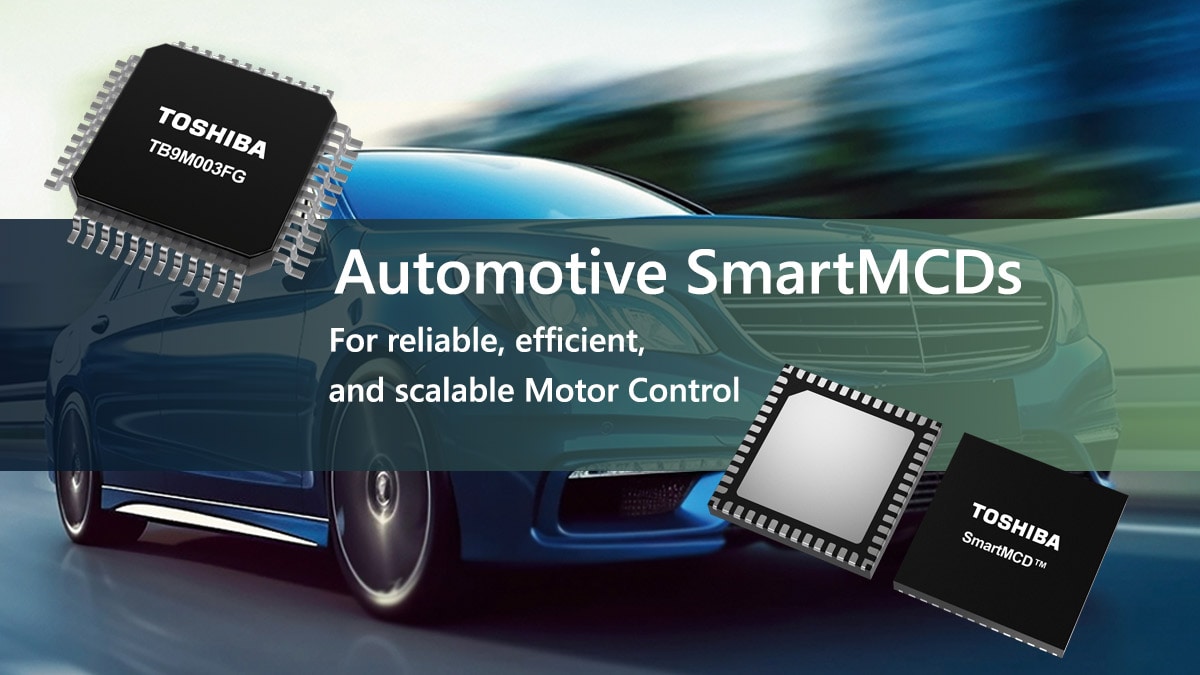
Smart Motor Control. Simplified.
Toshiba’s SmartMCD™ integrates microcontroller, motor driver, power management and LIN communication into a single automotive‑grade IC, enabling compact, efficient control of DC and BLDC motors in body electronics, pumps and fans.
Why Toshiba
With decades of automotive semiconductor expertise, Toshiba delivers highly integrated, AEC‑Q100‑qualified solutions that support system miniaturisation, functional safety and long‑term reliability, backed by robust tools, reference designs and local engineering support.
Sneak Peak
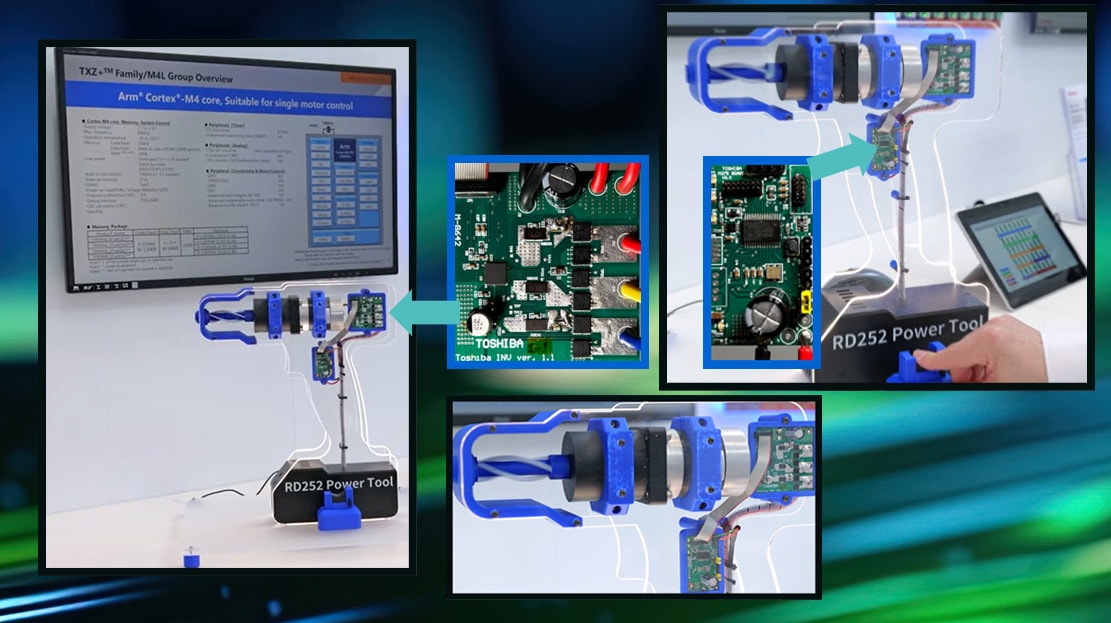
Power Tool Demo
Applications
- Power Tools
- Gardening Tools
Highlights
- Very compact design
- Flexibility by interchangeable Control MCU and
- Power Stage Boards for 12-48V battery voltages
Featured products
- Microcontroller specialized for Motor Control
- Recommended usage of TXZ+™4A Series, M4K Group
- Arm® Cortex®-M4 with Vector Engine*
significantly improves system performance - TB67Z833SFTG – Programable Gate-Driver for 3-Phase motor
- Serial SPI Interface to control and diagonstics
- Optional integrated current sense amplifier
- MOSFETs
- TPH1R204PB: 40V, 1.2mΩ, low-spike, 240A
- TPH2R408QM: 80V, 2.43mΩ, low-spike, 120A
*1 Vector Engine is an accelerator for field oriented control mathematical operation
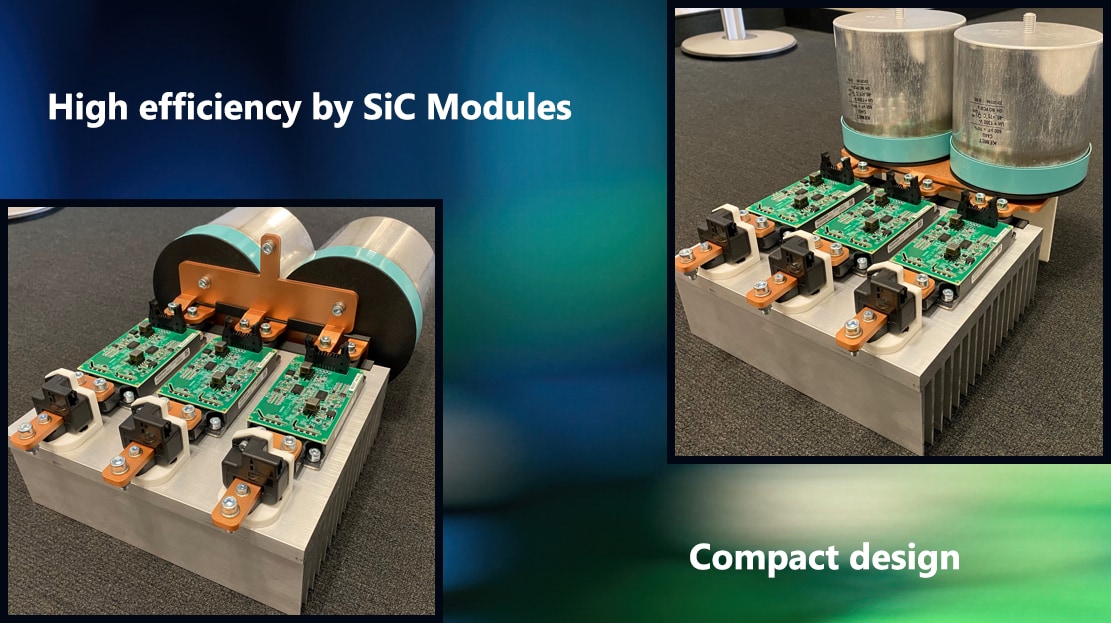
SiC Module Inverter
Applications
- Rail traction and Motor drive
Highlights
- High efficiency by SiC modules
- Compact design
- 2-153A1A package: High mounting compatibility to Si IGBT module / Lower loss characteristics than Si IGBT module / Low stray inductance
- RD237 - Gate Driver Solution for 1200V and 1700V SiC MOSFET Modules
Featured products
1200V – 600A/400A SiC module in 2-153A1A package
1700V – 400A/250A SiC module in 2-153A1A package
- RD237 - Gate Driver Solution for 1200V and 1700V SiC MOSFET Modules
More Info
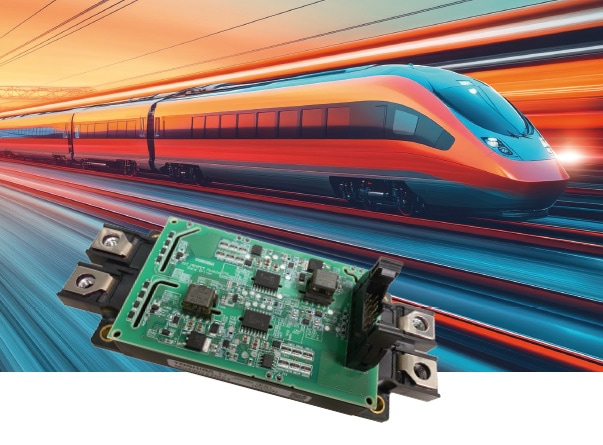
Gate Drive Circuit Solution for SiC MOSFET Module
The solution offers a built-in implementation of a SiC MOSFET Module. It provides an independent open-collector fault signal output of high-side and low-side. The output voltage is +20V (typ.) / -6.7V (typ.), the output current ±9.8A (max.) and the max. PWM frequency 50kHz.
TLP5231 – isolated pre-gate driver SSM6K804R – n-ch MOSFET
TPC8132 – p-ch MOSFET TCR1HF50B – LDO Regulator
SSM3K15AFS – n-ch MOSFET 2SC6026MFV – npn transistor
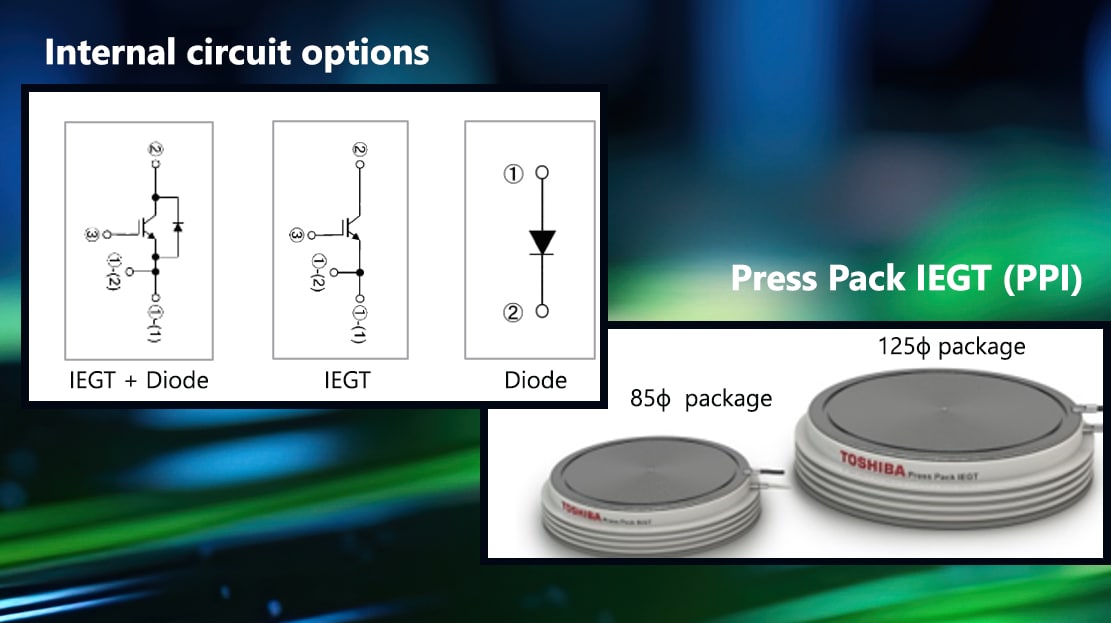
Press Pack IEGT (PPI)
Applications
- Motor drives, Transmission & Distribution, Power quality
Highlights
- Pressure contact with improved thermal fatigue
- Low thermal impedance due to double side cooling
- Moisture & weather resistant due to hermetic sealing
- Electrically shorted in failure for proper system operation
Featured products
- 3000A / 4500V – ST3000GXH35A (IEGT, ɸ125mm)
- 3000A / 4500V – 3000GXHH32 (Diode, ɸ85mm)
- 2000A / 4500V – ST2000GXH32 (IEGT + Diode, ɸ125mm)
- 1500A / 4500V – ST1500GXH35A (IEGT, ɸ85mm)
- 1000A / 4500V – ST1000GXH35 (IEGT + Diode, ɸ85mm)
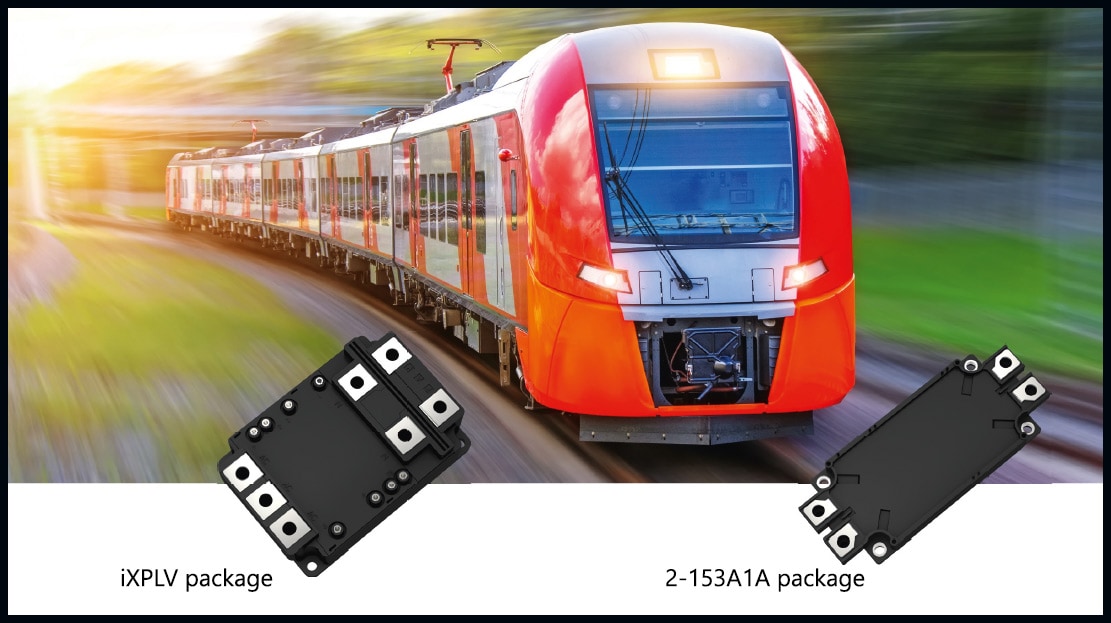
High Power SIC Modules
Applications
- Rail traction and Motor drive
Highlights
- iXPLV package (intelligent fleXible Package Low Voltage): High reliability by using silver sintering technology - High channel temperature(Tj,max = 175°C) - Low stray inductance
- 2-153A1A package: High mounting compatibility to Si IGBT module - Lower loss characteristics than Si IGBT module - Low stray inductance
Featured products
- MG600Q2YMS3 - 1200V / 600A /Package: 2-153A1A
- MG400Q2YMS3 - 1200V /400A /Package: 2-153A1A
- MG400V2YMS3 - 1700V / 400A /Package: 2-153A1A
- MG250V2YMS3 - 1700V / 250A /Package: 2-153A1A
- MG250YD2YMS - 2200V / 250A /Package: 2-153A1A
- MG800FXF2YMS3 - 3300V / 800A /Package: iXPLV
Company introduction
Videos
SmartMCD
Servo Drive Reference Model
Automated Guided Vehicle (AGV)
Time Sensitive Network
Innovation & Insights
How is Toshiba turning sustainability into real technological impact?
Kohei Onizuka, General Manager of Toshiba’s Regenerative Innovation Centre (RIC), shares how RIC is reshaping innovation in Europe, by starting not with technology, but with societal needs. Based in Düsseldorf, RIC bridges Toshiba’s engineering strengths with Europe’s drive for decarbonisation and the circular economy, pioneering concepts like regenerative data centres and energy‑water systems.
Curious how Toshiba plans to go beyond net‑zero?
Explore the full interview and discover how RIC is accelerating sustainable transformation across Europe.
Read the full interview
Question: Please let me know, what is the background for the creation of the Regenerative Innovation Centre here in Düsseldorf, and what makes RIC unique within Toshiba’s global innovation environment?
Answer: The Regenerative Innovation Centre (RIC) was established to lead innovations that embody Toshiba’s vision of “Committed to people, Committed to the future.”
One of the motivations for its establishment was the absence of Toshiba’s innovation functions in EU, despite the region’s global importance in sustainability.
Traditionally, Toshiba’s R&D and overseas research centres have excelled in creating world-first technologies driven by technical seeds. However, they faced challenges in areas essential for social implementation, such as design thinking, collaborative business development with partners, and above all, strong connections with local business units of Toshiba’s regional business units.
Rather than generating technologies from scratch, RIC’s uniqueness lies in its approach: carefully observing societal needs and market trends, and bridging the gap between core technologies and social implementation by connecting engineers, business units, and designers. This enables RIC to directly drive social innovation.
Question: What are the advantages to being based in Europe when it comes to regenerative R&D?
Answer: Above all, European countries, especially Germany, place sustainability at the core of their actions, with strong emphasis on decarbonisation and the circular economy. This makes Europe an ideal environment for Toshiba to learn and take on new challenges as it grows into a truly global company, including both areas where social implementation is progressing well and areas where challenges remain.
Europe also tends to formalise corporate social responsibility for sustainability through regulations. For Toshiba to continue operating successfully in Europe and globally, it is essential to engage more deeply with local communities, gain a better understanding of the realities on the ground, and ensure timely feedback into our business and products.
In this regard, our European partners, including companies, think tanks, research institutes, and universities, share a common perspective with us, which enables smooth and effective communication.
Question: Looking back over the past two years, are there already some achievements or breakthroughs through the activity of RIC?
Answer: Even looking back over just the past two years, the political and economic landscape in Europe and globally has continued to shift, and what we need to consider has evolved day by day.
Since the launch of RIC, we have been working closely with Toshiba’s business units in areas such as SCiB batteries, hydrogen, and negative emissions. These efforts have led to direct contributions to business challenges and the strong advancement of Europe-originated project proposals.
At the same time, we have made significant progress toward our longer-term goal of regenerative innovation, identifying several promising new domains and concrete approaches to pursue them. For example, data centres are becoming increasingly important to Toshiba’s business. Rather than treating them as mere profit-generating infrastructure, we have defined a direction that enhances social acceptance and contributes to both society and Toshiba’s business, by systematically ensuring sustainable power supply, delivering secondary benefits to citizens, and supporting regional regeneration.
This is precisely the kind of domain where RIC can serve as a driving force for positively leveraging Toshiba’s comprehensive strengths. To support this, we have begun developing digital tools for dialogue and co-creation with all stakeholders.
Furthermore, in Europe, advanced efforts are underway in the field of water resources. Specifically, the effective use of wastewater as a resource and the optimisation of entire river basins, including power plants and wastewater treatment facilities, are directly linked to regeneration. As this area aligns well with Toshiba’s business, we are now designing projects with potential partners.
Question: How do you measure the effectiveness of an innovation centre like yours—especially when working on long-term, regenerative technologies?
Answer: While contributing to short-term value creation in collaboration with Toshiba’s business units is one of RIC’s key missions, our long-term value lies in shaping the direction of next-generation products and services through a regenerative back-casting approach. We aim to enhance their value while keeping the short-term business perspective in mind.
As mentioned in the previous answers, for areas such as energy solutions for data centres or water-related businesses, the short-term focus tends to be on selling as many existing components and solutions as possible. While that is certainly important, RIC takes a broader view, addressing industrial challenges from a regenerative perspective, breaking down the solutions that will be needed, and exploring enabling technologies held by European research institutions.
For example, we have begun working with Toshiba Devices & Storage Corporation (TDSC) to link these insights to future product planning for semiconductors that may be handled by Toshiba Electronics Europe GmbH (TEE). This marks the beginning of a strategic initiative to align long-term innovation with Toshiba’s business roadmap.
Question: The concept of “regeneration” is central to your mission. How do you define it?
Answer: As businesses and economic activities advance, our lives have become more convenient, but it’s undeniable that the negative impact on the global environment has also increased. We are deeply concerned that simply aiming for net-zero may not be enough, not only to restore a “good state,” but even to achieve net-zero itself. That’s why we define a more positive trajectory beyond net-zero as “regeneration,” and we aim toward that.
This concept applies not only to the environment, but also to various societal challenges that have intensified alongside the progression of capitalism. The “regeneration” we envision is not in opposition to capitalism, but rather seeks to coexist with it. Our perspective is to treat regeneration and capitalism as two complementary forces working together to improve both the planet and human society.
Question: What’s the goal for the Regenerative Innovation Centre- Are there any upcoming projects or focus areas you’re particularly excited about?
Answer: As mentioned in the previous answers, numerous projects and focus areas have emerged. For example, in the data centre domain, we have identified several opportunities that can contribute to the growth of Toshiba’s European business in the short term. We will continue to serve as a counterpart to Toshiba Japan labs and business units.
However, short-term contributions alone are not sufficient as a goal for an innovation centre. RIC aims to go beyond the boundaries of Toshiba’s energy, digital infrastructure, and component business domains to create future products, solutions, and services that contribute to regeneration.
We are currently preparing a number of exciting projects, such as regenerative data centres and the coupling of energy and water utilities in ways that support regeneration.
Question: In the Toshiba Clip article from 2024 there’s was a strong emphasis on co-creation and collaboration e.g. with the Wuppertal Institute and University of Aachen. Can you point out how this helped the acceleration of your work?
Answer: The collaboration with RWTH Aachen University has clearly served as a catalyst for establishing our new office in Aachen and attracting top talents. In recent discussions, we have seen growing potential for Prof. Monti and his strong network of expertise and technologies to fill key gaps in Toshiba’s power transmission and distribution business, one of the pillars of our growth, and help Toshiba take a leading role in shaping the future of digital energy grids.
With Prof. Ramesohl of the Wuppertal Institute, we have received valuable support in defining and quantifying our vision of “regeneration.” As a next step, he is advising us on industrial dataspace initiatives, an area where many Japanese companies struggle to formulate strategies. His guidance is helping us explore how to balance economic rationality with a regeneration-oriented perspective, a challenge that touches on Toshiba’s company-wide strategic direction.
Question: What’s the most ‘out-of-the-box’ idea your team has seriously considered?
Answer: It goes without saying that the most out-of-the-box activities and development themes are those where RIC engages directly with business units and dives deeply into each business domain. However, this approach is not easily transferable to other domains, and in fact, highlights a broader challenge for Toshiba as a conglomerate: What does “out-of-the-box” look like when viewed across business domains?
As an answer to this question, RIC is currently developing a digital framework to support co-creation with customers. One example is the Bristol team’s development of a support tool for co-creating a mobile robot solution using SCiB batteries for logistics warehouses. This initiative contributed to securing customer orders in Japanese market that exceeded the budget expectations.
RIC is now working to expand this approach to other areas where Toshiba’s comprehensive strengths can drive business growth, such as data centres, next-generation energy distribution, and customer-side energy solutions. The goal is to generate out-of-the-box synergies that transcend individual business domains.
Question: What advice would you give to young engineers or researchers who want to work in a field that blends sustainability, innovation, and global impact?
Answer: It is about consistently balancing two perspectives: contributing to short-term business outcomes and economic rationality, while never losing sight of the mid- to long-term direction that we believe companies and society should pursue. This is extremely difficult. When working in a department focused on one side, it is easy to lose sight of the other, and organizational design plays a significant role in this.
Therefore, I believe the most effective approach is to be part of a team or organization that maintains a balanced view of both. Within that, I personally recommend studying areas such as systems thinking, system dynamics, and operations research as part of your intellectual foundation. These disciplines help you objectively understand conflicting societal challenges, and I believe they will also enable you to leverage the emerging generative AI technologies from a more informed and strategic perspective.
Question: What do you hope your legacy will be- not just in terms of technology, but in how Toshiba approaches innovation for future generations?
Answer: The goal, which relates to several of my previous questions, is to embed within Toshiba an organization and people capable of continuously generating innovations that reconcile economic rationality (capitalism) with corporate social responsibility. For many years, Toshiba’s research labs have been ahead of societal needs, creating remarkable “seeds” of technology that have formed the pillars of several Toshiba businesses. However, this one-way innovation approach has undeniably faced challenges in terms of business success probability and alignment with the accelerating pace of global innovation.
What is needed now are organizations and individuals who can strike a balanced perspective, connecting the trajectory of current businesses with future societal needs, while combining Toshiba’s strengths with missing pieces from outside the company to present viable solutions. This cannot be achieved by engineers who are solely interested in technology. We need a place where people, while maintaining their core expertise, can personally commit to reconciling capitalism with societal regeneration. I believe that leading innovation through such a collective is the approach Toshiba should take.
Question: Finally, I am curious: What’s the most ‘regenerative’ thing you do outside of work.
Answer: To stay focused on my work in Regenerative Innovation, I take care of my mental and physical well-being in regenerated natural environments like Eifel National Park. If you have any recommendations for food produced through “regenerative farming” or other “regenerative” activities, I would love to hear them!
(Interview was conducted 11/2025)
Future‑driven power technologies
Toshiba advances Power semiconductor technologies in lockstep with packaging, modelling and gate‑drive know‑how, underpinned by scaled 300 mm manufacturing in Kaga and AI‑driven process optimisation to accelerate learning cycles and reproducibility.
Why Toshiba: cross‑disciplinary R&D plus vertically aligned whitepapers, factories and packages that let engineers trade off loss, robustness and parasitics at system level, not just at die level.

Quality designed‑in and built‑in, not inspected‑in
Toshiba’s semiconductor Quality Guidelines formalise DR/AT (Design Review/Approval Test), rigorous change control, and SPC‑driven process monitoring from wafer to assembly, backing it up by structured reliability evaluation and continuous improvement loops.
Why Toshiba: a transparent, codified QA system that de‑risks qualifications and helps engineers predict lifetime behaviour under real operating stresses.

Device‑level efficiency, enterprise‑level decarbonisation
By cutting conduction and switching losses, Toshiba power devices lower system energy and thermal overheads; at the corporate level, Environmental Future Vision initiatives drive net‑zero targets across the value chain with TCFD‑aligned governance.
Why Toshiba: a tangible CO₂ reduction at both product and manufacturing scales for designs targeting stringent sustainability KPIs.