

- General Top
- SEMICONDUCTOR
- STORAGE
- COMPANY
-
My ToshibaSemicon
- Semiconductor Top
-
ApplicationsAutomotive
Body Electronics
xEV
In-Vehicle Infotainment
Advanced Driver-Assistance Systems (ADAS)
Chassis
IndustrialInfrastructure
BEMS/HEMS
Factory Automation
Commercial Equipment
Consumer/PersonalIoT Equipment
Healthcare
Wearable Device
Mobile
Computer Peripherals
-
ProductsAutomotive Devices
Discrete Semiconductor
Diodes
Transistors
Logic ICs
Analog Devices
- Automotive SmartMCD™ (Integreted SoC Conbining Microcontroller and Driver)
- Automotive Brushless Motor Driver ICs
- Automotive Brushed DC Motor Driver ICs
- Automotive Stepping Motor Driver ICs
- Automotive Driver ICs
- Automotive System Power Supplies ICs
- Automotive audio power amplifier ICs
- Automotive Network Communication
Digital Devices
Wireless Devices
※
 : Products list (parametric search)Power Semiconductors
SiC Power Devices
※
: Products list (parametric search)Isolators/Solid State RelaysPhotocouplers
Digital Isolators
Solid State Relays
Fiber Optic Transmitting Modules
※
: Products list (parametric search)MOSFETsIGBTs/IEGTsBipolar Transistors※
: Products list (parametric search)Diodes※
: Products list (parametric search)MicrocontrollersMotor Driver ICsIntelligent Power ICs※
: Products list (parametric search)Power Management ICsLinear ICs※
: Products list (parametric search)General Purpose Logic ICsLinear Image SensorsOther Product ICsOther Product ICs
※
: Products list (parametric search) -
Design & Development
Design & Development
Innovation Centre
At the Toshiba Innovation Centre we constantly strive to inspire you with our technologies and solutions. Discover how to place us at the heart of your innovations.
-
Knowledge
Knowledge
Highlighted Topics
Further Materials
Other
- Where To Buy




- Part Number & Keyword Search
- Cross Reference Search
- Parametric Search
- Stock Check & Purchase
This webpage doesn't work with Internet Explorer. Please use the latest version of Google Chrome, Microsoft Edge, Mozilla Firefox or Safari.
require 3 characters or more. Search for multiple part numbers fromhere.
The information presented in this cross reference is based on TOSHIBA's selection criteria and should be treated as a suggestion only. Please carefully review the latest versions of all relevant information on the TOSHIBA products, including without limitation data sheets and validate all operating parameters of the TOSHIBA products to ensure that the suggested TOSHIBA products are truly compatible with your design and application.Please note that this cross reference is based on TOSHIBA's estimate of compatibility with other manufacturers' products, based on other manufacturers' published data, at the time the data was collected.TOSHIBA is not responsible for any incorrect or incomplete information. Information is subject to change at any time without notice.
require 3 characters or more.
What happens after the overcurrent protection of the eFuse IC is activated and the IC is turned off?
Our eFuse ICs offer two options for recovery from overcurrent conditions: auto retry type and latched type.
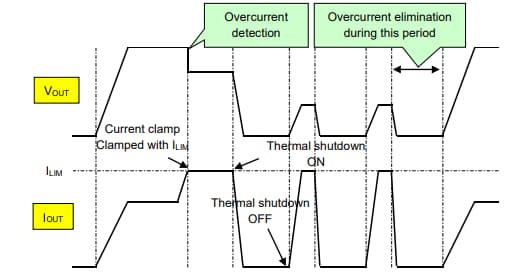
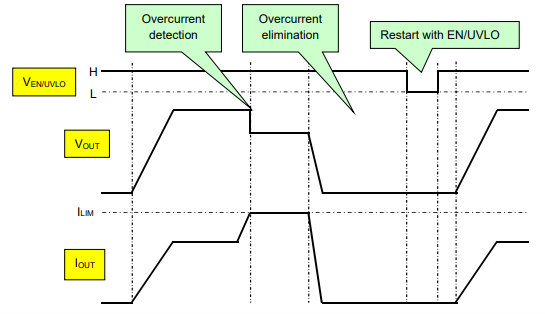
The users can select the appropriate one from the two options depending on system requirements. The following two figures are timing charts showing the auto retry type and latch type of the TCKE8 series as examples. For further details, please refer to the datasheet.
Auto-Retry Type
Limits the current that flows through eFuse IC to the inside MOSFET by ILIM when the current exceeds the overcurrent limit ILIM. At this time, eFuse IC occurs power loss PD= (VIN - VOUT)×ILIM and the junction temperature rises, thus moves to thermal shutdown operation and turns off MOSFET.
After MOSFET turns off, junction temperature become lowers, then MOSFET turns on again. If the overcurrent condition is not resolved, ILIM limits the current and then performs the thermal shutdown operation again. (Figure 1)
Latch Type
Like the auto-retry type, after limiting the current flowing through MOSFET when an overcurrent occurs with the current determined by ILIM, eFuse IC moves to thermal shutdown and turns off MOSFET. The latch type keeps MOSFET off.
To release the latch state, after the overcurrent state is resolved, set the voltage of the EN / UVLO pin to the “L” level and then set it to the “H” level again. (Figure 2)
Related Links
Please refer to the following pages and documents for product lineup and other documents.
FAQs
- What is eFuse IC (electronic fusing)?
- What applications are eFuse IC (electronic fuses) used for?
- What functions are built into eFuse IC (electronic fusing)?
- What is the difference between the overcurrent protection and the short-circuit protection of eFuse IC?
- How does thermal shutdown (TSD) of eFuse IC (electronic fuses) work?
Application Notes
* Company names, product names, and service names used in this FAQ may be of their respective companies.