

-
My ToshibaSemicon
- 반도체 탑
-
애플리케이션Automotive
Body Electronics
xEV
In-Vehicle Infotainment
Advanced Driver-Assistance Systems (ADAS)
Chassis
IndustrialInfrastructure
BEMS/HEMS
Factory Automation
Commercial Equipment
Consumer/PersonalIoT Equipment
Healthcare
Wearable Device
Mobile
Computer Peripherals
-
제품자동차 디바이스
Discrete Semiconductor
다이오드
트랜지스터
로직 IC
Analog Devices
- Automotive SmartMCD™ (Integreted SoC Conbining Microcontroller and Driver)
- Automotive Brushless Motor Driver Ics
- Automotive Brushed DC Motor Driver ICs
- Automotive Stepping Motor Driver ICs
- Automotive Driver ICs
- Automotive System Power Supplies ICs
- Automotive audio power amplifier ICs
- Automotive Network Communication
Digital Devices
Wireless Devices
※
 : Products list (parametric search)파워반도체
※
: Products list (parametric search)Isolators/Solid State RelaysPhotocouplers
Digital Isolators
Solid State Relays
Fiber Optic Transmitting Modules
※
: Products list (parametric search)MOSFETsIGBTs/IEGTs바이폴라 트랜지스터※
: Products list (parametric search)다이오드※
: Products list (parametric search)마이크로컨트롤러모터 드라이버 ICIntelligent Power ICs※
: Products list (parametric search)전원관리IC리니어 IC※
: Products list (parametric search)범용로직IC리니어 이미지 센서기타 제품용 IC기타 제품용 IC
※
: Products list (parametric search) -
개발/설계 지원
-
기술 자료
- 구매처



- 부품 번호 & 키워드 검색
- 상호 참조 검색
- 파라미터 검색
- 재고 확인 및 구매
This webpage doesn't work with Internet Explorer. Please use the latest version of Google Chrome, Microsoft Edge, Mozilla Firefox or Safari.
3글자 이상 입력하세요. Search for multiple part numbers fromhere.
The information presented in this cross reference is based on TOSHIBA's selection criteria and should be treated as a suggestion only. Please carefully review the latest versions of all relevant information on the TOSHIBA products, including without limitation data sheets and validate all operating parameters of the TOSHIBA products to ensure that the suggested TOSHIBA products are truly compatible with your design and application.Please note that this cross reference is based on TOSHIBA's estimate of compatibility with other manufacturers' products, based on other manufacturers' published data, at the time the data was collected.TOSHIBA is not responsible for any incorrect or incomplete information. Information is subject to change at any time without notice.
3글자 이상 입력하세요.
600V Power MOSFETs with Built-in Fast-Recovery Diodes for High-Efficiency Power Supplies
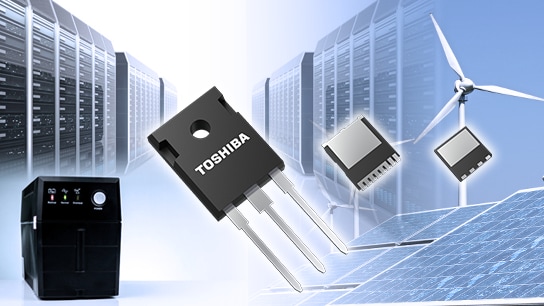
Toshiba Electronic Devices & Storage Corporation ("Toshiba") has added the "DTMOSVI 600V HSD (High-Speed Diode)"—N-channel power MOSFETs with built-in fast-recovery diodes—to the DTMOSVI 600V Series featuring a super junction structure. This series is suitable for applications such as data center servers, industrial equipment switching power supplies, and power conditioners for photovoltaic systems. The six new products are "TK034N60Z5, TK055N60Z5, and TK073N60Z5" in TO-247 packages; "TK055U60Z5 and TK073U60Z5" in TOLL packages; and "TK077V60Z5" in DFN8×8 packages.
The new products employ lifetime control technology[1] to enhance the reverse recovery characteristics of the body diode. This improves reverse recovery performance, which is critical for bridge and inverter circuit applications. Compared to Toshiba’s existing DTMOSVI 600V series products without built-in fast-recovery diodes, the reverse recovery time (trr) has been reduced by approximately 60%[2], and the reverse recovery charge (Qrr) by approximately 85%[2]. In the DTMOSVI 600V series, including the new products, optimized gate design and process reduce the figure of merit "drain-source On-resistance×total gate charge (RDS(ON)×Qg)" by approximately 36%[3], and "drain-source On-resistance×gate-drain charge (RDS(ON)×Qgd)" by approximately 52%[3] compared to Toshiba’s previous generation, the DTMOSIV-H series with the same voltage rating.
As a result, conduction, drive, and switching losses are reduced, contributing to higher efficiency in power supply circuits.
Toshiba offers tools that support circuit design for switching power supplies. Alongside the G0 SPICE model, which verifies circuit function in a short time, highly accurate G2 SPICE models that accurately reproduce transient characteristics are now available. Online Simulator available on Toshiba’s website allows users to easily verify circuit operation without the hassle of building a simulation environment and downloading element models.
Toshiba will continue to expand the DTMOSVI series lineup to improve the efficiency of switched-mode power supplies for industrial equipment, aiming to achieve carbon neutrality.
Notes:
[1] A technology that intentionally introduces defects into a semiconductor to enhance carrier recombination speed.
[2] Based on Toshiba's actual measurements (Comparison between Toshiba's existing product TK055U60Z1 and the new product TK055U60Z5.)
trr, Qrr measurement conditions: VDD=400V, VGS=0V, IDR=20A, -dIDR/dt=100A/μs, Ta=25°C
[3] Based on Toshiba's calculated estimate values
RDS(ON) measurement conditions: VGS=10V, Ta=25°C
Qg, Qgd measurement conditions: VDD≈400V, VGS=10V, Ta=25°C
Features
- Built-in fast-recovery diodes
- Low drain-source On-resistance×gate-drain charge (RDS(ON)×Qgd)
Explanation of Features
1. Built-in fast-recovery diodes
![Figure 1. Comparison of t<sub>rr</sub><sup>[2]</sup> and Q<sub>rr</sub><sup>[2]</sup> between DTMOSVI 600V HSD and existing DTMOSVI 600V](/content/dam/toshiba-ss-v3/master/en/semiconductor/product/mosfets/articles/600v-power-mosfets-with-built-in-fast-recovery-diodes-for-high-efficiency-power-supplies_features_1_en.png)
The new products employ lifetime control technology[1] to enhance the reverse recovery characteristics of body diodes. This improves reverse recovery performance, which is critical for bridge and inverter circuit applications.Compared to Toshiba’s existing DTMOSVI 600V series products without built-in fast-recovery diodes, the reverse recovery time (trr) has been reduced by approximately 60%[2], and the reverse recovery charge (Qrr) by approximately 85%[2].
2. Low drain-source On-resistance×gate-drain charge (RDS(ON)×Qgd)
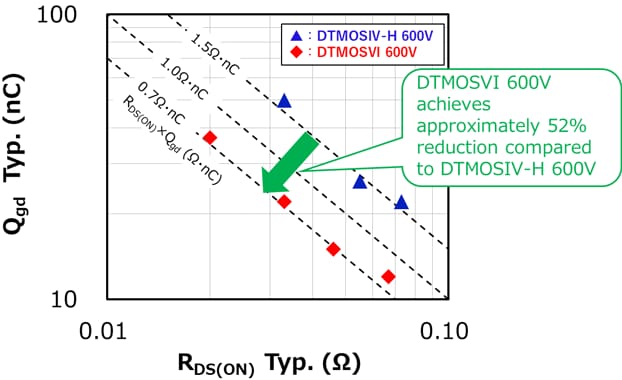
In the DTMOSVI 600V series, including the new products, optimized gate design and process reduce the figure of merit "drain-source On-resistance×gate-drain charge (RDS(ON)×Qgd)" by approximately 52%[3] compared to Toshiba’s previous generation, the DTMOSIV-H series with the same voltage rating. As a result, conduction, drive, and switching losses are reduced, contributing to higher efficiency in power supply circuits.
애플리케이션
- Switched-mode power supplies (for data center servers, etc.)
- Photovoltaic power conditioners
- Uninterruptible power supplies
Main Specifications
(Unless otherwise specified, Ta=25°C)
| Part number | Package name | Absolute maximum ratings | Electrical characteristics | Sample check & availability | |||||
|---|---|---|---|---|---|---|---|---|---|
| Drain-source voltage VDSS (V) | Drain current (DC) ID(A) | Drain-source On-resistance RDS(ON) (Ω) |
Total gate charge (gate-source plus gate-drain) Qg (nC) |
Gate-drain charge Qgd (nC) |
Input capacitance Ciss (pF) |
Reverse recovery time trr (ns) |
|||
| VGS=10V | VGS=10V | VGS=10V | VDS=300V | VDD=400V, -dIDR/dt= 100A/µs |
|||||
| Typ. | Typ. | Typ. | Typ. | Typ. | |||||
| TK034N60Z5 | TO-247 | 600 | 60 | 0.030 | 105 | 32 | 6200 | 160 |  |
| TK055N60Z5 | 40 | 0.048 | 66 | 20 | 3750 | 140 | |
||
| TK073N60Z5 | 32 | 0.063 | 50 | 17 | 2860 | 126 | |
||
| TK055U60Z5 | TOLL | 40 | 0.048 | 66 | 20 | 3750 | 140 | |
|
| TK073U60Z5 | 32 | 0.063 | 50 | 17 | 2860 | 126 | |
||
| TK077V60Z5 | DFN8×8 | 0.067 | |
||||||
Queries about purchasing, sampling and IC reliability
재고 확인 및 구매
3글자 이상 입력하세요.
Through this website you are able to proceed to the website of our distributors ("Third Party Website") which is not under the control of Toshiba Corporation and its subsidiaries and affiliates (collectively "Toshiba"). The Third Party Website is made available to you as a convenience only and you agree to use the Third Party Website at your own risk. The link of the Third Party Website does not necessarily imply a recommendation or an endorsement by Toshiba of the Third Party Website. Please be aware that Toshiba is not responsible for any transaction done through the Third Party Website, and such transactions shall be subject to terms and conditions which may be provided in the Third Party Website.
* Company names, product names, and service names may be trademarks of their respective companies.
* Information in this document, including product prices and specifications, content of services and contact information, is current on the date of the announcement but is subject to change without prior notice.