- General Top
- SEMICONDUCTOR
- STORAGE
- COMPANY
-
My ToshibaSemicon
- Semiconductor Top
-
ApplicationsAutomotive
Body Electronics
xEV
In-Vehicle Infotainment
Advanced Driver-Assistance Systems (ADAS)
Chassis
IndustrialInfrastructure
BEMS/HEMS
Factory Automation
Commercial Equipment
Consumer/PersonalIoT Equipment
Healthcare
Wearable Device
Mobile
Computer Peripherals
-
ProductsAutomotive Devices
Discrete Semiconductor
Diodes
Transistors
Logic ICs
Analog Devices
- Automotive SmartMCD™ (Integreted SoC Conbining Microcontroller and Driver)
- Automotive Brushless Motor Driver ICs
- Automotive Brushed DC Motor Driver ICs
- Automotive Stepping Motor Driver ICs
- Automotive Driver ICs
- Automotive System Power Supplies ICs
- Automotive audio power amplifier ICs
- Automotive Network Communication
Digital Devices
Wireless Devices
※
 : Products list (parametric search)Power Semiconductors
SiC Power Devices
※
: Products list (parametric search)Isolators/Solid State RelaysPhotocouplers
Digital Isolators
Solid State Relays
Fiber Optic Transmitting Modules
※
: Products list (parametric search)MOSFETsIGBTs/IEGTsBipolar Transistors※
: Products list (parametric search)Diodes※
: Products list (parametric search)MicrocontrollersMotor Driver ICsIntelligent Power ICs※
: Products list (parametric search)Power Management ICsLinear ICs※
: Products list (parametric search)General Purpose Logic ICsLinear Image SensorsOther Product ICsOther Product ICs
※
: Products list (parametric search) -
Design & Development
Design & Development
Innovation Centre
At the Toshiba Innovation Centre we constantly strive to inspire you with our technologies and solutions. Discover how to place us at the heart of your innovations.
-
Knowledge
Knowledge
Highlighted Topics
Further Materials
Other
- Where To Buy




- Part Number & Keyword Search
- Cross Reference Search
- Parametric Search
- Stock Check & Purchase
This webpage doesn't work with Internet Explorer. Please use the latest version of Google Chrome, Microsoft Edge, Mozilla Firefox or Safari.
require 3 characters or more. Search for multiple part numbers fromhere.
The information presented in this cross reference is based on TOSHIBA's selection criteria and should be treated as a suggestion only. Please carefully review the latest versions of all relevant information on the TOSHIBA products, including without limitation data sheets and validate all operating parameters of the TOSHIBA products to ensure that the suggested TOSHIBA products are truly compatible with your design and application.Please note that this cross reference is based on TOSHIBA's estimate of compatibility with other manufacturers' products, based on other manufacturers' published data, at the time the data was collected.TOSHIBA is not responsible for any incorrect or incomplete information. Information is subject to change at any time without notice.
require 3 characters or more.
Magnetic coupling is essential for high speed data isolation
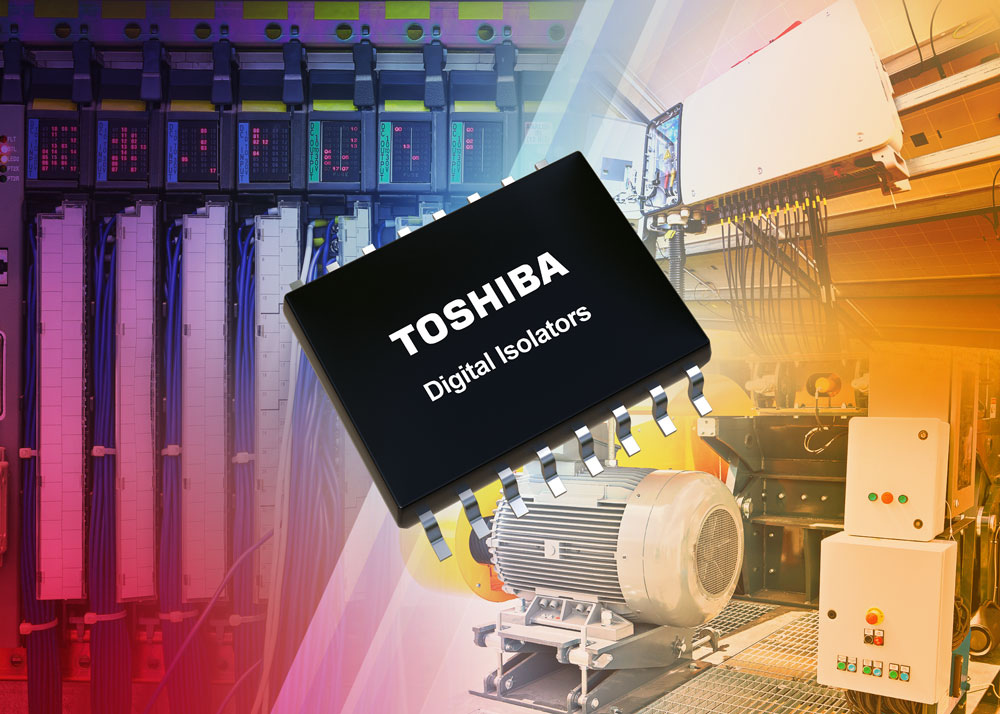
Isolation is a key requirement in many electronic systems where high- and low-voltage circuitry is present together. This is especially common in industrial, automotive and consumer applications. The presence of disparate voltages can lead to problems ranging from corrupted data to safety hazards.
Furthermore, as speeds increase to match required data throughput, then traditional approaches to isolation such as the use of optocouplers can be less than optimal.
Optocouplers use a combination of an LED, a transparent barrier and a photodetector to transmit signals. Due to the proportionality of the LED, analog signals can be conveyed, and as the transmission is via light, EMC resilience is generally good.
However, the response times of the LED and photodetector tend to limit this technology to around 50Mb/sec.
Early magnetic couplers used bulky discrete transformers although nowadays advances in semiconductor technology permit inductive components to be integrated into much smaller chip-level packages.
For example, Toshiba’s DCL54x01 series devices are built on two co-packaged chips that act as modulator and demodulator. Separated by a dual insulation barrier, magnetic coupling from the windings etched into the modulator passes the signal to the windings on the demodulation chip.
The highly integrated isolation within Toshiba’s magnetic coupling technology ensures safe operation where high currents and voltages are present. The DCL54x01 incorporates a double-isolation structure to ensure safe operation, even under conditions where voltage surges may reach 12.8kV.
As well as the air gap between the co-packaged chips, an insulation film that resists high voltages protects the electrical structures, preventing short circuits if the primary isolation fails. This robust approach meets the demands of the VDE V 0884-11 standard.
Even in these rugged environments, the DCL54x01 offers an insulation lifetime that is estimated at 70 years, based on measurements using standard time-dependent dielectric breakdown (TDDB) tests with 1.2kVrms pulses.
This high level of durability is ideal for green/renewable energy and other industrial applications where the intended service life may extend for decades.
Toshiba’s DCL54x01 provides an effective and space-efficient solution in electrically challenging environments where high system frequencies and elevated data rates are necessary.Isolation is a key requirement in many electronic systems where high- and low-voltage circuitry is present together. This is especially common in industrial, automotive and consumer applications. The presence of disparate voltages can lead to problems ranging from corrupted data to safety hazards.