-
My ToshibaSemicon
- 반도체 탑
-
애플리케이션Automotive
Body Electronics
xEV
In-Vehicle Infotainment
Advanced Driver-Assistance Systems (ADAS)
Chassis
IndustrialInfrastructure
BEMS/HEMS
Factory Automation
Commercial Equipment
Consumer/PersonalIoT Equipment
Healthcare
Wearable Device
Mobile
Computer Peripherals
-
제품자동차 디바이스
Discrete Semiconductor
다이오드
트랜지스터
로직 IC
Analog Devices
- Automotive SmartMCD™ (Integreted SoC Conbining Microcontroller and Driver)
- Automotive Brushless Motor Driver Ics
- Automotive Brushed DC Motor Driver ICs
- Automotive Stepping Motor Driver ICs
- Automotive Driver ICs
- Automotive System Power Supplies ICs
- Automotive audio power amplifier ICs
- Automotive Network Communication
Digital Devices
Wireless Devices
※
 : Products list (parametric search)파워반도체
※
: Products list (parametric search)Isolators/Solid State RelaysPhotocouplers
Digital Isolators
Solid State Relays
Fiber Optic Transmitting Modules
※
: Products list (parametric search)MOSFETsIGBTs/IEGTs바이폴라 트랜지스터※
: Products list (parametric search)다이오드※
: Products list (parametric search)마이크로컨트롤러모터 드라이버 ICIntelligent Power ICs※
: Products list (parametric search)전원관리IC리니어 IC※
: Products list (parametric search)범용로직IC리니어 이미지 센서기타 제품용 IC기타 제품용 IC
※
: Products list (parametric search) -
개발/설계 지원
-
기술 자료
- 구매처



- 부품 번호 & 키워드 검색
- 상호 참조 검색
- 파라미터 검색
- 재고 확인 및 구매
This webpage doesn't work with Internet Explorer. Please use the latest version of Google Chrome, Microsoft Edge, Mozilla Firefox or Safari.
3글자 이상 입력하세요. Search for multiple part numbers fromhere.
The information presented in this cross reference is based on TOSHIBA's selection criteria and should be treated as a suggestion only. Please carefully review the latest versions of all relevant information on the TOSHIBA products, including without limitation data sheets and validate all operating parameters of the TOSHIBA products to ensure that the suggested TOSHIBA products are truly compatible with your design and application.Please note that this cross reference is based on TOSHIBA's estimate of compatibility with other manufacturers' products, based on other manufacturers' published data, at the time the data was collected.TOSHIBA is not responsible for any incorrect or incomplete information. Information is subject to change at any time without notice.
3글자 이상 입력하세요.
What are the DIR pin and /OE pin on a level shifter IC?
The DIR pin determines the communication direction of the input/output pins, and the /OE pin controls whether the level shifter's output is enabled or disabled.
The “DIR pin” on bidirectional level shifters stands for Direction and determines the communication direction. Setting DIR to a high level enables communication from pin A to pin B, while setting it to a low level enables communication from pin B to pin A. This pin allows you to determine the signal communication direction.
The “/OE pin” stands for Output Enable and controls the on/off state of the output pins. The “/OE” pin with a slash (bar) enables communication at the L level and becomes an input impedance at the H level. The “OE” pin without a slash (bar) behaves in the opposite manner.
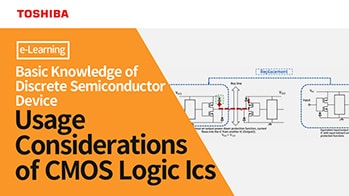
When multiple ICs are connected to the same signal line, a bus conflict (collision) may occur. In this case, controlling the output via the OE pin allows enabling the output only when necessary, while setting other ICs to Hi-Z prevents collisions.
Multiple outputs from a general-purpose CMOS logic IC come into conflict (Short-circuiting)
| Terminal | Explanation | State | Action |
|---|---|---|---|
| DIR | Determine the data communication direction | 1 (High) | A → B |
| 0 (Low) | B → A | ||
| /OE | Determine output ON/OFF | 0 (Low) | Output enabled (ON) |
| 1 (High) | Output disabled (OFF) |
Related Links
The following documents also contain related information.