

- General Top
- SEMICONDUCTOR
- STORAGE
- COMPANY
-
My ToshibaSemicon
- Semiconductor Top
-
ApplicationsAutomotive
Body Electronics
xEV
In-Vehicle Infotainment
Advanced Driver-Assistance Systems (ADAS)
Chassis
IndustrialInfrastructure
BEMS/HEMS
Factory Automation
Commercial Equipment
Consumer/PersonalIoT Equipment
Healthcare
Wearable Device
Mobile
Computer Peripherals
-
ProductsAutomotive Devices
Discrete Semiconductor
Diodes
Transistors
Logic ICs
Analog Devices
Digital Devices
Wireless Devices
※
 : Products list (parametric search)Power Semiconductors
SiC Power Devices
※
: Products list (parametric search)Isolators/Solid State RelaysPhotocouplers
Digital Isolators
Solid State Relays
Fiber Optic Transmitting Modules
※
: Products list (parametric search)MOSFETsIGBTs/IEGTsBipolar Transistors※
: Products list (parametric search)Diodes※
: Products list (parametric search)MicrocontrollersMotor Driver ICsIntelligent Power ICs※
: Products list (parametric search)Power Management ICsLinear ICs※
: Products list (parametric search)General Purpose Logic ICsLinear Image SensorsOther Product ICsOther Product ICs
※
: Products list (parametric search) -
Design & Development
-
Knowledge
- Where To Buy



- Part Number & Keyword Search
- Cross Reference Search
- Parametric Search
- Stock Check & Purchase
This webpage doesn't work with Internet Explorer. Please use the latest version of Google Chrome, Microsoft Edge, Mozilla Firefox or Safari.
require 3 characters or more. Search for multiple part numbers fromhere.
The information presented in this cross reference is based on TOSHIBA's selection criteria and should be treated as a suggestion only. Please carefully review the latest versions of all relevant information on the TOSHIBA products, including without limitation data sheets and validate all operating parameters of the TOSHIBA products to ensure that the suggested TOSHIBA products are truly compatible with your design and application.Please note that this cross reference is based on TOSHIBA's estimate of compatibility with other manufacturers' products, based on other manufacturers' published data, at the time the data was collected.TOSHIBA is not responsible for any incorrect or incomplete information. Information is subject to change at any time without notice.
require 3 characters or more.
Automotive Ethernet Bridge ICs
More and more road vehicles now have on-board connectivity, equipping them with internet and cellular access, and allowing information to be shared among on-board systems and devices and with external systems and services. On top of this, low latency communications are essential for advanced driver assistance systems (ADAS) and autonomous driving technologies. These developments all require more complex automotive communication systems supported by reliable transmission standards with real-time data delivery. The Ethernet TSN standard was developed expressly to meet these needs.
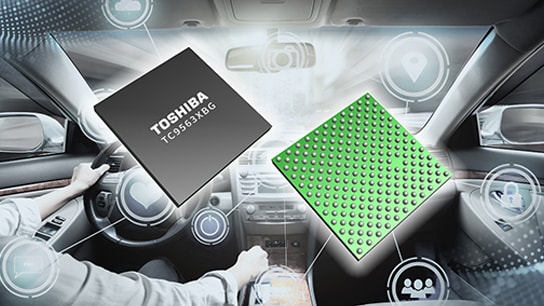
TC956x Series, that are an Ethernet bridge IC for an next generation of in the car network system, are the products
which supports Ethernet AVB/TSN to be performed the high speed and synchronous network system for Automotive.
An automotive Ethernet bridge IC connects a host processor or SoC to an in-vehicle Ethernet network and supports the interfaces and timing functions required for high-speed automotive communications. Toshiba’s TC956x series supports Ethernet AVB/TSN for applications that require synchronized, low-latency data delivery, including IVI and telematics systems.
Automotive Ethernet is used as vehicle networks move toward higher-bandwidth and lower-latency communications. Toshiba’s TC956x lineup supports AVB/TSN Ethernet and provides host connectivity through interfaces such as PCIe, with the TC9563 adding two Ethernet ports capable of up to 10Gbps and PCIe Gen3 switch connectivity for a host SoC and additional PCIe devices.
Automotive Ethernet Bridge ICs FAQs
What is an automotive Ethernet bridge IC?
Why is Ethernet used in automotive networks?
What is TSN in automotive Ethernet?
What is the difference between Ethernet AVB and TSN on Toshiba automotive bridge ICs?
How does a Toshiba automotive Ethernet bridge connect to the host SoC?
Lineup
| Product name | TC9560XBG | TC9560BXBG | TC9562XBG | TC9562AXBG | TC9562BXBG | ||
|---|---|---|---|---|---|---|---|
| Application | Ethernet AVB/TSN bridge solution for automotive application | ||||||
| Functions and Feature | Ethernet feature | Up to 1Gbps: 1 port | Up to 10Gbps: 2 ports | ||||
| Host (External application) I/F | PCIe® I/F [Gen2 (5GT/s), Gen1 (2.5GT/s), Endpoint, Single lane] |
- | PCIe® I/F [Gen2 (5GT/s), Gen1 (2.5GT/s), Endpoint, Single lane] |
PCIe® I/F [Gen3 (8GT/s), Gen2 (5GT/s), Gen1 (2.5GT/s), Endpoint, Up to 4 lanes] | |||
| - | HSIC I/F (480 Mbps) | - | |||||
| PCIe® switch feature | - | Gen3 (8GT/s), Gen2 (5GT/s), Gen1 (2.5GT/s), Port 1: Up to 2 lanes, Port 2: 1 lane | |||||
| Automotive I/F | Ethernet AVB [IEEE802.1AS, IEEE802.1Qav] MAC | ||||||
| - | Ethernet TSN [IEEE802.1Qbv, IEEE802.1Qbu, IEEE802.3br] MAC |
||||||
| Ethernet PHY I/F | RGMII/RMII/MII | RGMII/RMII/MII/SGMII | Port A: USXGMII/XFI/SGMII Port B: USXGMII/XFI/SGMII/RGMII |
||||
| Audio I/F | I2S/TDM | - | |||||
| Peripheral I/F | I2C/SPI, Quad SPI, UART, GPIO, INT | I2C/SPI, UART, GPIO, INT | |||||
| CPU Core | Arm®Cortex®-M3 | ||||||
| Package (Pitch) | PLFBGA170 (0.65) | PLFBGA120 (0.65) | PLFBGA220 (0.65) | ||||
| Supply Voltage (V) | 1.8/3.3 for IO 1.8/2.5/3.3 for RGMII/RMII/MII 1.1 for Core | 1.8/3.3 for IO 1.2 for HSIC 1.8/2.5/3.3 for RGMII/RMII/MII 1.1 for Core | 1.8/3.3 for IO 1.8 for SGMII 1.8/2.5/3.3 for RGMII/RMII/MII 1.1 for Core |
1.8/3.3 for IO 1.8 for USXGMII/XFI/SGMII/RGMII 0.9 for Core |
|||
*: New Product
TC9560/TC9562 series features
Related information
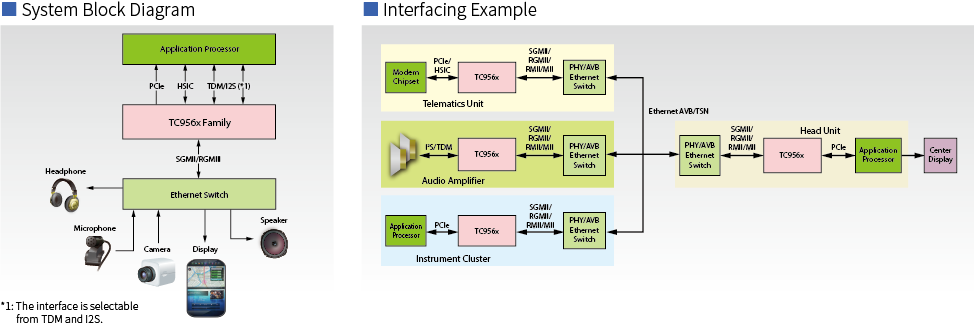
- The TC9560/9562 series supports standards such as IEEE 802.1AS and IEEE 802.1Qav generally referred to as Ethernet-AVB, and such as IEEE 802.1Qbv, IEEE 802.1Qbu and IEEE 802.3br generally referred to as Ethernet TSN. Connected to an application processor or other SoC host, the TC9560/9562 series allows the host device to deliver audio, video, and data through the 10/100/1000 Ethernet network in an automotive environment.
- The connection to the host is via PCIe® running at 2.5/5.0 GT/s (PCIe Gen1.0/2.0), 480 Mbps HSIC or TDM (Time Division Multiplex)/I2S for audio traffic.
- Provides an Ethernet PHY interface selectable from SGMII, RGMII, RMII and MII.
- The design target is to achieve a low-power mode that typically consumes 1 mW at room temperature (measured by Toshiba). The TC9560/9562 series typically takes only 100 ms to return to normal operation (measured by Toshiba) in order to meet the market need. The TC9560/9562 series is scheduled to obtain AEC-Q100 Grade 3 qualification.
TC9563 features
- The TC9563 supports standards such as IEEE 802.1AS and IEEE 802.1Qav generally referred to as Ethernet-AVB, and such as IEEE 802.1Qbv, IEEE 802.1Qbu and IEEE 802.3br generally referred to as Ethernet TSN.
Provides 2-port 10Gbps Ethernet PHY interface selectrable from USXGMII, XFI, SGMII, and RGMII. - The TC9563 has three PCIe® running at 2.5/5.0/8.0 GT/s (PCIe Gen1.0/2.0/3.0) switch ports for communications with the host SoC and connection to devices equipped with PCIe interfaces.
- The PCIe switch part is configured with one 4-lane upstream port for connection with the host SoC and two 1-lane downstream ports for connection to devices with a PCIe interface.
Recommended product
Applications

With In-vehicle Infotainment (IVI) and telematics systems poised to grow rapidly, the usage of Automotive Interface Bridge ICs is expected to rise significantly. Automotive systems are now becoming more sophisticated, requiring greater functionality and higher performance, while new interface standards for in-vehicle equipment have increased. To solve the interface gap between peripheral devices and systems-on-chip (SoCs), Toshiba offers both Automotive Peripheral Bridge ICs and Automotive Ethernet Bridge ICs. Toshiba's Automotive Ethernet Bridge ICs are designed to achieve the highest performance in our next generation of in car network systems by supporting Ethernet AVB/TSN to empower the high speedperformance.
* PCIe® and PCI Express® are registered trademarks of PCI-SIG.
* Arm and Cortex are registered trademarks of Arm Limited (or its subsidiaries) in the US and/or elsewhere.
* Other company names, product names, and service names may be trademarksof their respective companies.