

- General Top
- SEMICONDUCTOR
- STORAGE
- COMPANY
-
My ToshibaSemicon
- Semiconductor Top
-
ApplicationsAutomotive
Body Electronics
xEV
In-Vehicle Infotainment
Advanced Driver-Assistance Systems (ADAS)
Chassis
IndustrialInfrastructure
BEMS/HEMS
Factory Automation
Commercial Equipment
Consumer/PersonalIoT Equipment
Healthcare
Wearable Device
Mobile
Computer Peripherals
-
ProductsAutomotive Devices
Discrete Semiconductor
Diodes
Transistors
Logic ICs
Analog Devices
- Automotive SmartMCD™ (Integreted SoC Conbining Microcontroller and Driver)
- Automotive Brushless Motor Driver ICs
- Automotive Brushed DC Motor Driver ICs
- Automotive Stepping Motor Driver ICs
- Automotive Driver ICs
- Automotive System Power Supplies ICs
- Automotive audio power amplifier ICs
- Automotive Network Communication
Digital Devices
Wireless Devices
※
 : Products list (parametric search)Power Semiconductors
SiC Power Devices
※
: Products list (parametric search)Isolators/Solid State RelaysPhotocouplers
Digital Isolators
Solid State Relays
Fiber Optic Transmitting Modules
※
: Products list (parametric search)MOSFETsIGBTs/IEGTsBipolar Transistors※
: Products list (parametric search)Diodes※
: Products list (parametric search)MicrocontrollersMotor Driver ICsIntelligent Power ICs※
: Products list (parametric search)Power Management ICsLinear ICs※
: Products list (parametric search)General Purpose Logic ICsLinear Image SensorsOther Product ICsOther Product ICs
※
: Products list (parametric search) -
Design & Development
-
Knowledge
Knowledge
- Where To Buy




- Part Number & Keyword Search
- Cross Reference Search
- Parametric Search
- Stock Check & Purchase
This webpage doesn't work with Internet Explorer. Please use the latest version of Google Chrome, Microsoft Edge, Mozilla Firefox or Safari.
require 3 characters or more. Search for multiple part numbers fromhere.
The information presented in this cross reference is based on TOSHIBA's selection criteria and should be treated as a suggestion only. Please carefully review the latest versions of all relevant information on the TOSHIBA products, including without limitation data sheets and validate all operating parameters of the TOSHIBA products to ensure that the suggested TOSHIBA products are truly compatible with your design and application.Please note that this cross reference is based on TOSHIBA's estimate of compatibility with other manufacturers' products, based on other manufacturers' published data, at the time the data was collected.TOSHIBA is not responsible for any incorrect or incomplete information. Information is subject to change at any time without notice.
require 3 characters or more.
Are there Mux / De-Mux type bus switches supporting PCIe® Gen 6.0, PCIe® Gen 5.0, Thunderbolt™ 5, Thunderbolt™ 4, USB4®?
For a bus switch to support these communication interfaces, it must have high-frequency characteristics sufficient for the communication speeds of the standards. Toshiba's TDS4A212MX, TDS4B212MX, TDS5B212MX, and TDS5C212MX are bus switch products for these high-speed standards.
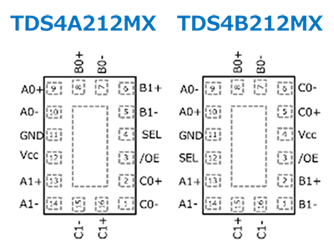
These four products have the same function and the same package, but have different high-frequency characteristics and pinouts. TDS4B212MX and TDS5B212MX have the same pinout.
The supported standards are as follows:
- TDS5B212MX / TDS5C212MX: PCIe® Gen 6.0, PCIe® Gen 5.0, Thunderbolt™ 5, Thunderbolt™ 4, USB4®
- TDS4A212MX / TDS4B212MX: PCIe® Gen 5.0, Thunderbolt™ 4, USB4®
| Item | TDS4A212MX | TDS4B212MX | TDS5B212MX | TDS5C212MX |
|---|---|---|---|---|
| Operaring Supply voltage | 1.6 to 3.6V | |||
| -3dB Bandwidth | 26.2GHz | 27.5GHz | 29GHz | 34GHz |
| Differential insertion loss @16GHz | -1.4dB | -1.3dB | -1.2dB | -1.2dB |
| Differential return loss @16GHz | -18dB | -16dB | -15dB | -14dB |
| Differential OFF isolation @16GHz | -11dB | -14dB | -27dB | -24dB |
| Differential crosstalk @16GHz | -30dB | -36dB | -31dB | -31dB |
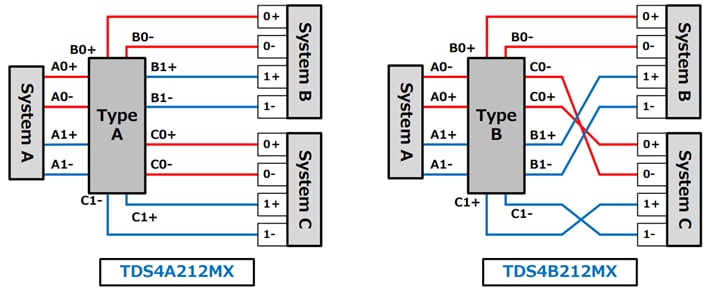
The features of each pin arrangement are described below.
The TDS4A212MX has a pinout that maintains the positional relationship of the input differential-pair signals when they are output. Therefore, in a system arrangement such as in Fig. 2, a layout without crossing wiring is possible. The TDS4B212MX and TDS5B212MX have a pinout with short internal wiring that suppresses signal attenuation. Therefore, they have higher high-frequency characteristics than the TDS4A212MX.
The TDS5C212MX adopts a pinout that further optimizes the high-frequency characteristics, achieving a higher bandwidth than the TDS5B212MX.
Please refer to the following technical articles and application notes for the Eye Pattern evaluation using the S-parameter and PCIe®5-signal.
Technical article: Bus switch supporting high-speed digital signals of PCIe® Gen 5.0 and USB4®
Application note for TDS4A212MX, TDS4B212MX: For high-speed differential interface 32Gbps MUX/DEMUX bus switch TDS4A212MX, TDS4B212MX (PDF: 1.6MB)
Application note for TDS5B212MX, TDS5C212MX: For high-speed differential interface 64GT/s Mux/De-Mux bus-switch TDS5B212MX, TDS5C212MX Application Note (PDF: 2.2MB)
Related Links
The following documents also contain related information.
FAQs
Product Lists
Application Notes
- CMOS Logic ICs Selection Guide (PDF: 759KB)
- CMOS Logic ICs Usage Considerations (PDF: 1.61MB)
- Basics of CMOS Logic ICs (PDF: 1.21MB)
- Glossary of CMOS Logic ICs (PDF: 417KB)
- CMOS Logic ICs Standard series (PDF: 1.37MB)
- For high-speed differential interface 32Gbps MUX/DEMUX bus-switch TDS4A212MX, TDS4B212MX (PDF: 1.6MB)
Catalog

* PCIe® is a trademark of PCI-SIG.
* USB4® is a trademark of USB Implementers Forum.
* Thunderbolt™ is a trademark of Intel Corporation or its subsidiaries.
* Other company names, product names, and service names may be trademarks of their respective companies.