

- General Top
- SEMICONDUCTOR
- STORAGE
- COMPANY
-
My ToshibaSemicon
- Semiconductor Top
-
ApplicationsAutomotive
Body Electronics
xEV
In-Vehicle Infotainment
Advanced Driver-Assistance Systems (ADAS)
Chassis
IndustrialInfrastructure
BEMS/HEMS
Factory Automation
Commercial Equipment
Consumer/PersonalIoT Equipment
Healthcare
Wearable Device
Mobile
Computer Peripherals
-
ProductsAutomotive Devices
Discrete Semiconductor
Diodes
Transistors
Logic ICs
Analog Devices
- Automotive SmartMCD™ (Integreted SoC Conbining Microcontroller and Driver)
- Automotive Brushless Motor Driver ICs
- Automotive Brushed DC Motor Driver ICs
- Automotive Stepping Motor Driver ICs
- Automotive Driver ICs
- Automotive System Power Supplies ICs
- Automotive audio power amplifier ICs
- Automotive Network Communication
Digital Devices
Wireless Devices
※
 : Products list (parametric search)Power Semiconductors
SiC Power Devices
※
: Products list (parametric search)Isolators/Solid State RelaysPhotocouplers
Digital Isolators
Solid State Relays
Fiber Optic Transmitting Modules
※
: Products list (parametric search)MOSFETsIGBTs/IEGTsBipolar Transistors※
: Products list (parametric search)Diodes※
: Products list (parametric search)MicrocontrollersMotor Driver ICsIntelligent Power ICs※
: Products list (parametric search)Power Management ICsLinear ICs※
: Products list (parametric search)General Purpose Logic ICsLinear Image SensorsOther Product ICsOther Product ICs
※
: Products list (parametric search) -
Design & Development
-
Knowledge
- Where To Buy



- Part Number & Keyword Search
- Cross Reference Search
- Parametric Search
- Stock Check & Purchase
This webpage doesn't work with Internet Explorer. Please use the latest version of Google Chrome, Microsoft Edge, Mozilla Firefox or Safari.
require 3 characters or more. Search for multiple part numbers fromhere.
The information presented in this cross reference is based on TOSHIBA's selection criteria and should be treated as a suggestion only. Please carefully review the latest versions of all relevant information on the TOSHIBA products, including without limitation data sheets and validate all operating parameters of the TOSHIBA products to ensure that the suggested TOSHIBA products are truly compatible with your design and application.Please note that this cross reference is based on TOSHIBA's estimate of compatibility with other manufacturers' products, based on other manufacturers' published data, at the time the data was collected.TOSHIBA is not responsible for any incorrect or incomplete information. Information is subject to change at any time without notice.
require 3 characters or more.
Lineup Expansion of the "74AVC Series" Dual Power-Supply Bus Transceivers with New 1-bit and 2-bit Products
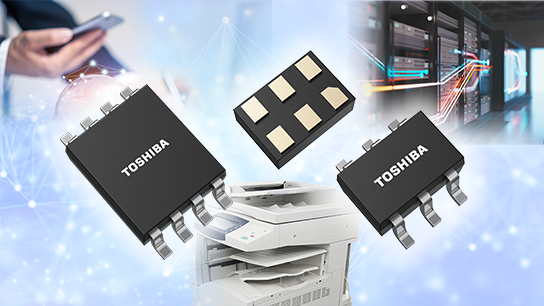
Toshiba Electronic Devices & Storage Corporation ("Toshiba") has expanded its lineup of dual power‑supply bus transceivers, the "74AVC Series" with four new 1‑bit products—74AVC1T45NX, 74AVCH1T45NX, 74AVC1T45FU, and 74AVCH1T45FU—and two new 2‑bit products—74AVC2T45FK and 74AVCH2T45FK.
In recent years, the rapid advancement of AI technologies has driven significant expansion in data center and edge AI[1] markets. Therefore, SoC systems[2] increasingly require higher performance with lower power consumption, leading to further reductions in operating voltage.
The 74AVC Series is designed to enable communication between such low‑voltage systems and conventional voltage systems. It is a level shifter capable of bidirectional voltage-level shifting between 0.7V or 0.8V[3] and up to 3.6V.
In addition to the existing 4-bit products, smaller bit configurations (1-bit and 2-bit) and small package variations—such as the leadless XSON6, the leaded SOT-363 (US6), and SOT-765 (US8)—are available, providing even greater flexibility in system design.
Furthermore, the newly launched 1-bit and 2-bit products, as with the existing products, employ a push-pull buffer[4] configuration to achieve high-speed operation, making them suitable for a wide range of applications such as UART[5], GPIO[6], and SPI[7] communication interfaces.
The 74AVC Series devices—including the new products—support dual power‑supplies without any power-on/off sequence restrictions. They adopt a clear directional-control method using DIR pins and a high-impedance control method using power-supply pins. The 74AVCH Series additionally includes an internal bus-hold function[8].
These features provide the following advantages:
- Simplified power-on sequence design, helping to reduce the risk of malfunction
- Prevention of signal-line contention through directional control and high-impedance mode, thereby improving system reliability
- In the case of the 74AVCH Series, the bus-hold function avoids undefined states and enables stable signal retention, contributing to a reduction in external components such as pull-up and pull-down resistors
Toshiba will continue to expand its lineup of low-voltage logic ICs to meet increasingly diverse system‑design requirements and contribute to energy savings for a more efficient and sustainable society.
| Part number | Number of circuits |
Supply voltage | Package | Size (W×L×H, mm) |
Bus-hold function |
|---|---|---|---|---|---|
| 74AVC1T45NX | 1-bit | 0.7V to 3.6V | XSON6 | 1.45×1.0×0.48 | No |
| 74AVCH1T45NX | Yes | ||||
| 74AVC1T45FU | 0.8V to 3.6V | SOT-363 (US6) | 2.0×2.1×0.9 | No | |
| 74AVCH1T45FU | Yes | ||||
| 74AVC2T45FK | 2-bit | SOT-765 (US8) | 2.0×3.1×0.7 | No | |
| 74AVCH2T45FK | Yes | ||||
| 74AVC4T245FT[9] | 4-bit (2×2-bit) | 0.7V to 3.6V | TSSOP16B | 5.0×6.4×1.2 | No |
| 74AVCH4T245FT[9] | Yes | ||||
| 74AVC4T345FT[9] | 4-bit (3+1-bit) | No |
Notes:
[1] AI technology that performs data processing and analysis at the edge, where the data is generated, rather than in the cloud. The term "edge" refers to endpoint devices located close to users or the field, including smartphones, sensors, drones, surveillance cameras, and IoT devices.
[2] Abbreviation for system on a Chip (SoC), which refers to a system that integrates multiple functions onto a single semiconductor chip. Components such as the CPU (processor), memory, and input/output interfaces—which were traditionally implemented as separate ICs—are integrated into a single chip.
[3] Refer to the lineup above for the classification of power‑supply voltages.
[4] A circuit that combines NPN and PNP transistors (or NMOS and PMOS) in the output stage.
[5] UART (Universal Asynchronous Receiver/Transmitter): A transmit/receive circuit for asynchronous serial communication. A protocol used for transmitting and receiving data asynchronously.
[6] An abbreviation for General Purpose Input/Output, a general-purpose signal pin used in electronic devices, microcontrollers, and SoCs.
[7] Serial Peripheral Interface: Synchronous serial communication. A protocol used for transmitting and receiving data synchronously.
[8] A function that retains the previous input state (High or Low) even when the input pin becomes open (floating).
[9] Existing product
Features
- Low-voltage operation and flexible voltage support (0.7V or 0.8V to 3.6V)
- Suitable for UART, GPIO, and SPI communication interfaces
- Industry-standard-size small packages
Features Explanation
1. Low-voltage operation and flexible voltage support (0.7V or 0.8V to 3.6V)
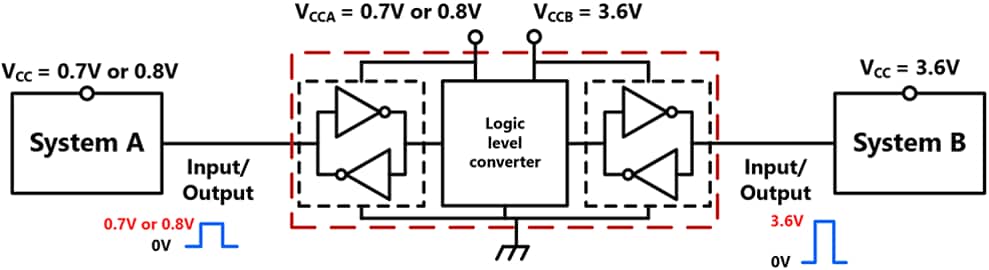
The 74AVC series offers flexible voltage level shifting at low operating voltages, supporting a wide range of voltage systems.
- 74AVC1T45NX, 74AVCH1T45NX: 0.7V to 3.6V
- 74AVC1T45FU, 74AVCH1T45FU, 74AVC2T45FK, 74AVCH2T45FK: 0.8V to 3.6V
Input/output voltages can be freely configured.
Either power-supply can serve as the source or destination for level-up/level-down conversion.
2. Suitable for UART, GPIO, and SPI communication interfaces
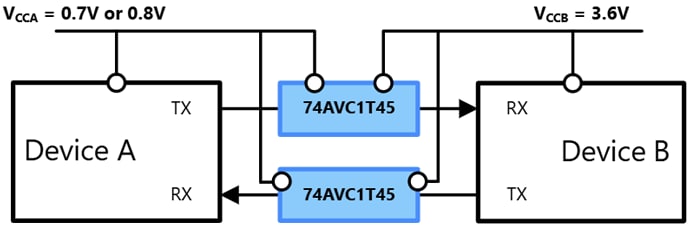
With a push-pull configuration that supports high-speed operation and 1-bit or 2-bit options that enable circuit configurations tailored to different communication interfaces, the products can be used with a wide range of interfaces such as UART, GPIO, and SPI.
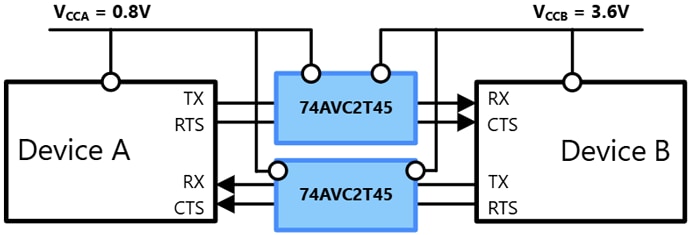
In a two-line configuration for the UART interface, the 1-bit product (74AVC1T45) allows individual level-shifting of each line, while the 2-bit product (74AVC2T45) allows level-shifting two lines at a time in a four-line configuration. By selecting the appropriate bit width, the circuit can be configured.
3. Industry-standard-size small packages
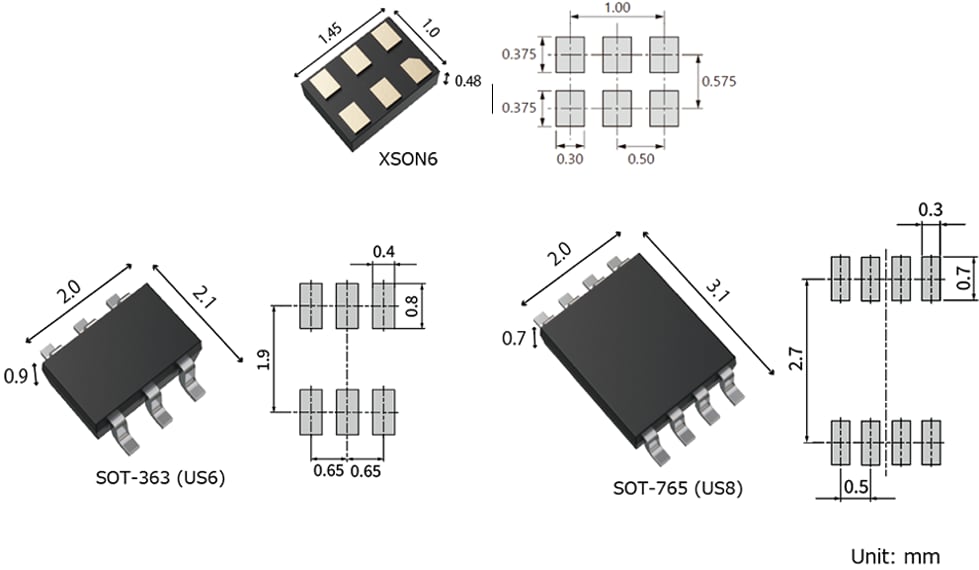
- 74AVC1T45NX, 74AVCH1T45NX: XSON6
- 74AVC1T45FU, 74AVCH1T45FU: SOT‑363 (US6)
- 74AVC2T45FK, 74AVCH2T45FK: SOT‑765 (US8)
They are offered in industry‑standard small packages.
Applications
Industrial equipment
- Data centers, servers, communication equipment, FA equipment (such as programmable logic controllers (PLC)), testers, multifunction printers (MFP), POS terminals, power tools, etc.
Consumer/personal equipment - Tablets, Laptop PCs, smartphones, audio devices, wearables
Main Specifications
| Part number | Without bus-hold | 74AVC1T45NX | 74AVC1T45FU | 74AVC2T45FK | ||
|---|---|---|---|---|---|---|
| With bus-hold | 74AVCH1T45NX | 74AVCH1T45FU | 74AVCH2T45FK | |||
| Packages | Name | XSON6 | SOT-363 (US6) | SOT-765 (US8) | ||
| Size W×L×H (mm) | Typ. | 1.45×1.0×0.48 | 2.0×2.1×0.9 | 2.0×3.1×0.7 | ||
| Operating ranges | Supply voltage VCCA, VCCB (V) | 0.7 to 3.6 | 0.8 to 3.6 | |||
| Output current IOUTA, IOUTB (mA) | VCCA, VCCB =3.0 to 3.6V |
±12 | ||||
| Operating temperature Topr (°C) | -40 to 125 | |||||
| DC Characteristics (Ta=-40 to 85°C) |
High-level input voltage VIHA, VIHB (V) |
VCCA, VCCB =3.0 to 3.6V |
Min | 2.0 | ||
| Low-level input voltage VILA, VILB (V) |
Max | 0.9 | ||||
| Quiescent supply current ICCA, ICCB (μA) |
Max | 1 (74AVC1T45NX) | 2 | 5 | ||
| 2 (74AVCH1T45NX) | ||||||
| AC Characteristics (Ta=-40 to 85°C) |
Propagation delay time tPLH/tPHL (ns) |
VCCA, VCCB =3.0 to 3.6V |
Max | 3.7 | 3.9 | |
| Sample check & availability | Without bus-hold |  |
|
|
||
| With bus-hold | |
|
|
|||
Related information
How to Level Shift Using One Gate Logic (PDF: 494KB)
Selection Guide 2026 Small Signal and Logic Devices (PDF: 8.7MB)
Queries about purchasing, sampling and IC reliability
Stock Check & Purchase
require 3 characters or more.
Through this website you are able to proceed to the website of our distributors ("Third Party Website") which is not under the control of Toshiba Corporation and its subsidiaries and affiliates (collectively "Toshiba"). The Third Party Website is made available to you as a convenience only and you agree to use the Third Party Website at your own risk. The link of the Third Party Website does not necessarily imply a recommendation or an endorsement by Toshiba of the Third Party Website. Please be aware that Toshiba is not responsible for any transaction done through the Third Party Website, and such transactions shall be subject to terms and conditions which may be provided in the Third Party Website.
* Company names, product names, and service names may be trademarks of their respective companies.
* Information in this document, including product prices and specifications, content of services and contact information, is current on the date of the announcement but is subject to change without prior notice.