

- General Top
- SEMICONDUCTOR
- STORAGE
- COMPANY
-
My ToshibaSemicon
- Semiconductor Top
-
ApplicationsAutomotive
Body Electronics
xEV
In-Vehicle Infotainment
Advanced Driver-Assistance Systems (ADAS)
Chassis
IndustrialInfrastructure
BEMS/HEMS
Factory Automation
Commercial Equipment
Consumer/PersonalIoT Equipment
Healthcare
Wearable Device
Mobile
Computer Peripherals
-
ProductsAutomotive Devices
Discrete Semiconductor
Diodes
Transistors
Logic ICs
Analog Devices
- Automotive SmartMCD™ (Integreted SoC Conbining Microcontroller and Driver)
- Automotive Brushless Motor Driver ICs
- Automotive Brushed DC Motor Driver ICs
- Automotive Stepping Motor Driver ICs
- Automotive Driver ICs
- Automotive System Power Supplies ICs
- Automotive audio power amplifier ICs
- Automotive Network Communication
Digital Devices
Wireless Devices
※
 : Products list (parametric search)Power Semiconductors
SiC Power Devices
※
: Products list (parametric search)Isolators/Solid State RelaysPhotocouplers
Digital Isolators
Solid State Relays
Fiber Optic Transmitting Modules
※
: Products list (parametric search)MOSFETsIGBTs/IEGTsBipolar Transistors※
: Products list (parametric search)Diodes※
: Products list (parametric search)MicrocontrollersMotor Driver ICsIntelligent Power ICs※
: Products list (parametric search)Power Management ICsLinear ICs※
: Products list (parametric search)General Purpose Logic ICsLinear Image SensorsOther Product ICsOther Product ICs
※
: Products list (parametric search) -
Design & Development
-
Knowledge
- Where To Buy



- Part Number & Keyword Search
- Cross Reference Search
- Parametric Search
- Stock Check & Purchase
This webpage doesn't work with Internet Explorer. Please use the latest version of Google Chrome, Microsoft Edge, Mozilla Firefox or Safari.
require 3 characters or more. Search for multiple part numbers fromhere.
The information presented in this cross reference is based on TOSHIBA's selection criteria and should be treated as a suggestion only. Please carefully review the latest versions of all relevant information on the TOSHIBA products, including without limitation data sheets and validate all operating parameters of the TOSHIBA products to ensure that the suggested TOSHIBA products are truly compatible with your design and application.Please note that this cross reference is based on TOSHIBA's estimate of compatibility with other manufacturers' products, based on other manufacturers' published data, at the time the data was collected.TOSHIBA is not responsible for any incorrect or incomplete information. Information is subject to change at any time without notice.
require 3 characters or more.
Ideal Diode Controller with Reverse Polarity Protection and Overvoltage Protection
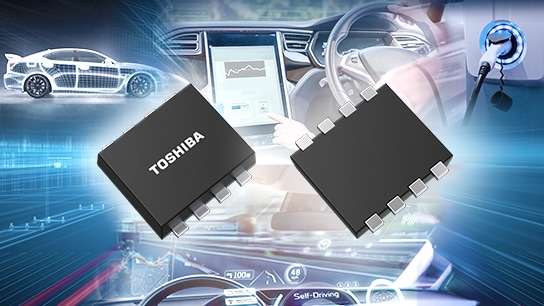
Toshiba Electronic Devices & Storage Corporation ("Toshiba") has launched the ideal diode[1] controller "TPD7110F" that allows safe power control in automotive systems and contributes to design flexibility and space-saving.
In recent years, as automotive ECUs (Electronic Control Units) have become more advanced, their current consumption has also increased. Traditionally, diodes have been used for reverse polarity protection of power supplies and for reverse current blocking on the load side.
However, rising current demands now require larger diodes and additional heat dissipation, which hinders equipment miniaturization.
As a result, demand has been growing for ideal diodes that suppress heat generation by reducing power loss during conduction in power lines, and supporting miniaturization.
In addition, redundant configurations[2] are required for automotive safety design, accelerating the trend towards redundancy in power systems and increasing the importance of ideal diode controllers in such systems.
To meet these needs, through the built-in charge pump circuit (with an internal capacitor) and its combination with an N-channel MOSFET, the product enables the configuration of a low-loss ideal diode. In addition to reverse polarity protection and reverse current blocking from the load side, it also incorporates an overvoltage protection. By using multiple units of this product, redundant power systems can be constructed. Additionally, pairing with back-to-back MOSFETs enables ON/OFF control as a load switch.
Moreover, the low current consumption design achieves an operating current consumption of 100µA (typ.). Additionally, standby current consumption is 2µA (typ.), which helps reduce battery consumption. This helps to overall system efficiency and reduction of environmental impact.
Furthermore, by adopting Toshiba’s unique small package "PS-8" and combining it with low on-resistance N-channel MOSFETs to realize ideal diodes, it helps reduce power loss in a wide range of equipment and enables equipment miniaturization.
Toshiba will continue to expand its lineup of products that deliver lower loss, miniaturization, and high reliability, contributing to the development of a safe and sustainable mobility society.
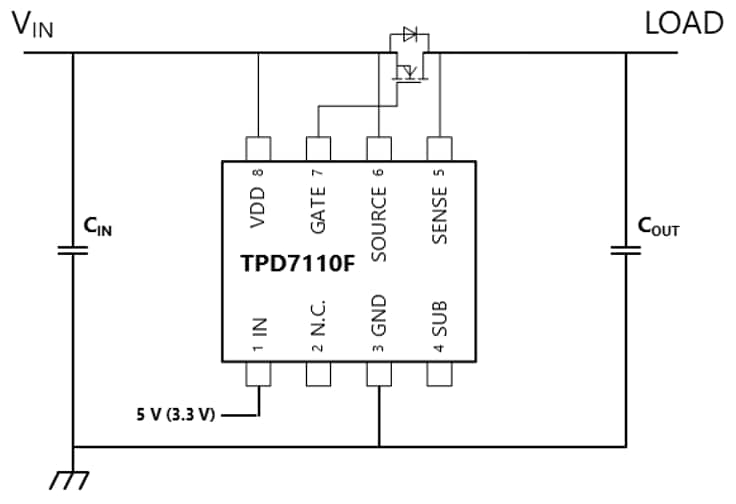
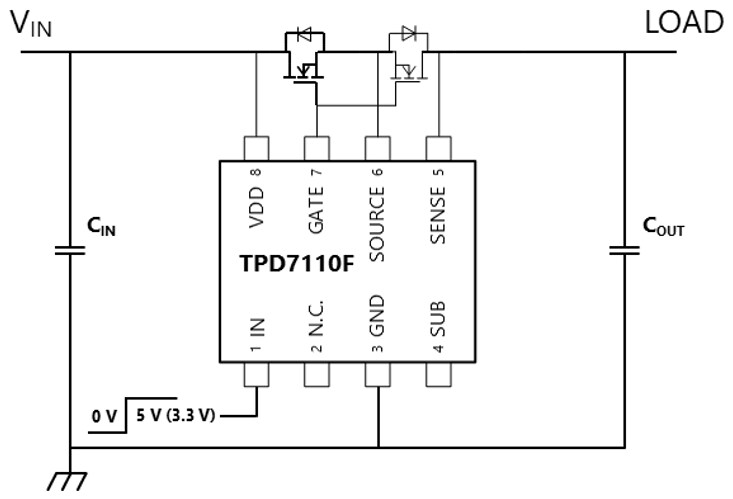
Notes:
[1] An ideal diode is a circuit or device that aims for "ideal" characteristics while having the function of allowing current to flow in only one direction, like existing diodes (rectifying elements).
[2] Redundant configuration refers to a design policy that duplicates or multiplies important systems such as control systems and sensor systems to ensure the safety of autonomous vehicles.
Features
- Reverse polarity protection
- Overvoltage protection
- Low current consumption design minimizes battery load
Operating current consumption=100µA (typ.)/Standby current consumption=2µA (typ.) - Small package PS-8 for high-density mounting
Features Explanation
1. Reverse polarity protection
In automotive systems, connection errors with batteries or power lines may occur. The new product has a built-in reverse polarity protection circuit, which turns off the N-channel MOSFET during reverse connection to protect circuits and equipment from damage even if the power polarity is mistakenly reversed.
2. Overvoltage protection
When the battery voltage enters an overvoltage condition due to events such as voltage surges, the product turns OFF the N-channel MOSFET. This prevents the equipment on the load side from being damaged by overvoltage[3]. Once the battery voltage returns to its normal level, the product turns the N-channel MOSFET ON again.
Note:
[3] In the case where MOSFETs are used in a back‑to‑back configuration.
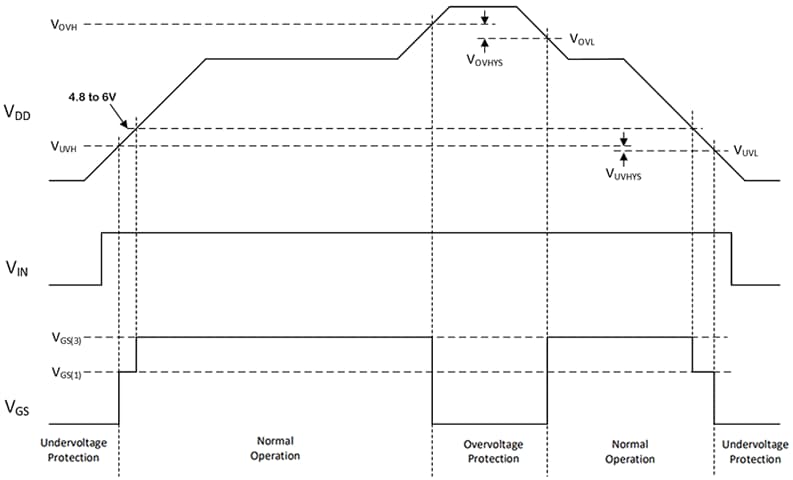
VOVH: Overvoltage detection voltage, VOVL: Overvoltage release voltage, VOVHYS: Overvoltage detection hysteresis
VUVL: Undervoltage detection voltage, VUVH: Undervoltage release voltage, VUVHYS: Undervoltage detection hysteresis
VGS: Gate-to-source voltage, VGS(1): High level output voltage(1), VGS(3): High level output voltage(3)
Figure 3. Operation diagram of overvoltage protection (and undervoltage protection)
3. Low current consumption design minimizes battery load
Operating current consumption=100µA (typ.)
/Standby current consumption=2µA (typ.)
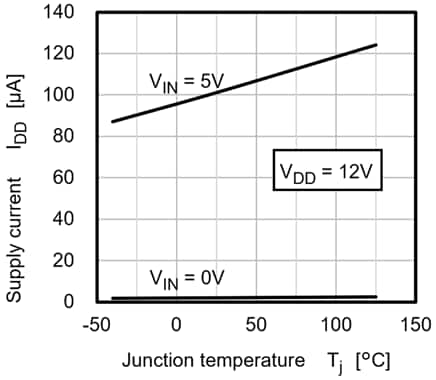
This product achieves an extremely low operating current consumption of 100µA (typ.) for a product with a built-in charge pump capacitor, due to its low current consumption design. Additionally, standby current consumption is only 2µA (typ.), which helps reduce unnecessary battery consumption. This contributes to overall system efficiency and reduction of environmental impact.
4. Small package PS-8 for high-density mounting
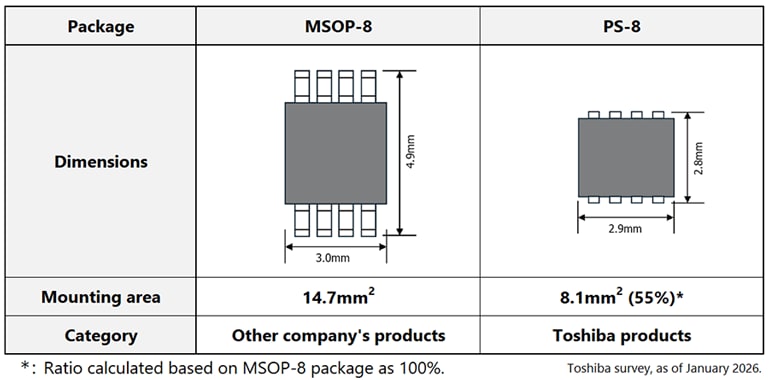
TPD7110F adopts Toshiba’s unique small package PS-8 (SON8-P). Although it is an easy-to-mount lead type, its dimensions are extremely small at 2.9mm×2.8mm×0.8mm, and its mounting area is reduced to approximately 55% compared to the common small SOP package MSOP-8.
Furthermore, as mentioned earlier, this product has a built-in charge pump circuit (with an internal capacitor), achieving significant space-saving compared to other products that require external capacitors.
Applications
- Body Control Module (BCM)
- Battery Management System (BMS)
- Head-Up Display (HUD)
Main Specifications
(Unless otherwise specified, Ta=25°C)
| Part number | TPD7110F | |||
|---|---|---|---|---|
| Package | Name | PS-8 | ||
| Size (mm) | 2.9×2.8 | |||
| Pin pitch (mm) | 0.65 | |||
| Absolute maximum ratings |
Power supply voltage VDD(1) (V) | -0.3 to 60 | ||
| Power supply voltage under reverse connection VDD(2) (V) |
-32 | |||
| Input voltage (1) VIN (V) | -0.3 to 6 | |||
| Input voltage (2) VSENSE (V) | -0.3 to 60 | |||
| Input voltage (3) VSOURCE (V) | -0.3 to 60 | |||
| Output voltage VGATE (V) | -0.3 to 60 | |||
| Output source current IGS(-) (µA) | Internal capacity | |||
| Output sink current IGS(+) (mA) | 200 | |||
| Allowable power dissipation PD (W) | 0.99 | |||
| Operating temperature Topr (°C) | -40 to 125 | |||
| Junction temperature Tj (°C) | 150 | |||
| Storage temperature Tstg (°C) | -55 to 150 | |||
| Operating range | Operating supply voltage VDD(opr) (V) |
Tj=-40 to 125°C | 3 to 32 | |
| Electrical characteristics |
Supply current IDD(ON1) (µA) | VDD=12V, VIN=5V, Tj=25°C |
Typ. | 100 |
| Supply current IDD(OFF1) (µA) | VDD=12V, VIN=0V, Tj=25°C |
Typ. | 2 | |
| Protective functions | Reverse polarity protection Reverse current blocking Overvoltage protection Undervoltage protection |
|||
| Sample check & availability |  |
|||
Queries about purchasing, sampling and IC reliability
Stock Check & Purchase
require 3 characters or more.
Through this website you are able to proceed to the website of our distributors ("Third Party Website") which is not under the control of Toshiba Corporation and its subsidiaries and affiliates (collectively "Toshiba"). The Third Party Website is made available to you as a convenience only and you agree to use the Third Party Website at your own risk. The link of the Third Party Website does not necessarily imply a recommendation or an endorsement by Toshiba of the Third Party Website. Please be aware that Toshiba is not responsible for any transaction done through the Third Party Website, and such transactions shall be subject to terms and conditions which may be provided in the Third Party Website.
* Company names, product names, and service names may be trademarks of their respective companies.
* Information in this document, including product prices and specifications, content of services and contact information, is current on the date of the announcement but is subject to change without prior notice.