

- General Top
- SEMICONDUCTOR
- STORAGE
- COMPANY
-
My ToshibaSemicon
- Semiconductor Top
-
ApplicationsAutomotive
Body Electronics
xEV
In-Vehicle Infotainment
Advanced Driver-Assistance Systems (ADAS)
Chassis
IndustrialInfrastructure
BEMS/HEMS
Factory Automation
Commercial Equipment
Consumer/PersonalIoT Equipment
Healthcare
Wearable Device
Mobile
Computer Peripherals
-
ProductsAutomotive Devices
Discrete Semiconductor
Diodes
Transistors
Logic ICs
Analog Devices
- Automotive SmartMCD™ (Integreted SoC Conbining Microcontroller and Driver)
- Automotive Brushless Motor Driver ICs
- Automotive Brushed DC Motor Driver ICs
- Automotive Stepping Motor Driver ICs
- Automotive Driver ICs
- Automotive System Power Supplies ICs
- Automotive audio power amplifier ICs
- Automotive Network Communication
Digital Devices
Wireless Devices
※
 : Products list (parametric search)Power Semiconductors
SiC Power Devices
※
: Products list (parametric search)Isolators/Solid State RelaysPhotocouplers
Digital Isolators
Solid State Relays
Fiber Optic Transmitting Modules
※
: Products list (parametric search)MOSFETsIGBTs/IEGTsBipolar Transistors※
: Products list (parametric search)Diodes※
: Products list (parametric search)MicrocontrollersMotor Driver ICsIntelligent Power ICs※
: Products list (parametric search)Power Management ICsLinear ICs※
: Products list (parametric search)General Purpose Logic ICsLinear Image SensorsOther Product ICsOther Product ICs
※
: Products list (parametric search) -
Design & Development
-
Knowledge
Knowledge
- Where To Buy




- Part Number & Keyword Search
- Cross Reference Search
- Parametric Search
- Stock Check & Purchase
This webpage doesn't work with Internet Explorer. Please use the latest version of Google Chrome, Microsoft Edge, Mozilla Firefox or Safari.
require 3 characters or more. Search for multiple part numbers fromhere.
The information presented in this cross reference is based on TOSHIBA's selection criteria and should be treated as a suggestion only. Please carefully review the latest versions of all relevant information on the TOSHIBA products, including without limitation data sheets and validate all operating parameters of the TOSHIBA products to ensure that the suggested TOSHIBA products are truly compatible with your design and application.Please note that this cross reference is based on TOSHIBA's estimate of compatibility with other manufacturers' products, based on other manufacturers' published data, at the time the data was collected.TOSHIBA is not responsible for any incorrect or incomplete information. Information is subject to change at any time without notice.
require 3 characters or more.
Automotive CXPI Responder Interface IC Enabling Shorter Software Development Time Through a Microcontroller-less Configuration Enters Mass Production
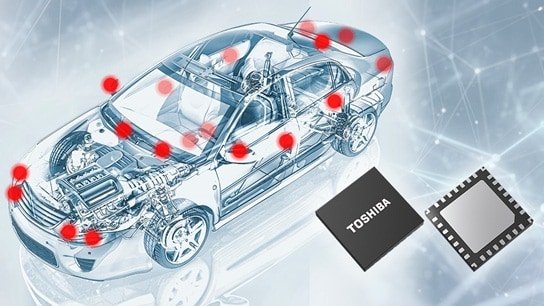
Toshiba Electronic Devices & Storage Corporation ("Toshiba") has started mass production of the "TB9033FTG," an interface IC for automotive CXPI[1] responder nodes[2] compliant with the CXPI automotive communication protocol standard. The product is the industry’s first[3] interface IC for automotive CXPI responder nodes to pass conformance testing based on ISO 20794-7[4] conducted by an independent third-party organization[5]. With its standard compliance confirmed, it helps improve the development efficiency of CXPI network systems.
In recent years, automobiles have incorporated increasing levels of electronic control, resulting in a growing number of body electronics end nodes, such as switches, sensors, and lighting devices. As a result, the engineering effort required to develop microcontroller control software for each node has increased, creating a need for more efficient automotive system development. In addition, the increase in wire harness weight resulting from dedicated wiring to switches, sensors and actuators has become an issue.
The TB9033FTG implements CXPI protocol processing and GPIO[6] control through hardware logic[7]. This eliminates the need for a microcontroller and associated control software development in responder nodes equipped with the device, helping reduce development effort and shorten time-to-market. In addition, signals that previously required individual wiring can be multiplexed through CXPI communication, contributing to lower vehicle weight and system costs by reducing wire harnesses.
The product also features 16 GPIO pins, six of which can be used as A/D converter[8] inputs and four as PWM[9] outputs. It includes input monitoring during sleep mode[10], support for switch matrix inputs of up to 4×4[11], and output control in the event of communication loss. The device supports a wide range of automotive body applications, including steering wheel switches, operation panels, lighting control, and sensor inputs.
In addition, the product incorporates abnormality detection functions for overheating, overvoltage and undervoltage. It also features an abnormality pre-detection function that automatically notifies the commander node[12] before an abnormal condition occurs. The operating temperature range is -40°C to 125°C, and compliance with AEC-Q100 Grade 1 is planned, contributing to enhanced reliability of automotive systems. Toshiba has also released the reference designs "Automotive CXPI Communication Application Circuit B (Door Mirror Drive Board/CXPI Responder Node)" and "Automotive CXPI Communication Application Circuit C (LED Ambient Light Drive Board/CXPI Responder Node)," both of which use this product. The reference designs provide circuit design considerations, design data, and other information that customers can use in their designs.
Toshiba will continue to expand its CXPI product lineup, helping improve development efficiency, reduce system costs, and advance automotive networks. Toshiba will also promote the realization of automotive systems supporting next-generation E/E architectures[13].
Notes:
[1] CXPI (Clock Extension Peripheral Interface):
An automotive communication protocol standard developed in Japan by the Society of Automotive Engineers of Japan (JSAE) and established as the international standard ISO 20794 in 2020. It is designed to reduce wire harnesses and multiplex signals between devices in HMI applications.
[2] Responder node: A node on a CXPI network that responds to requests from a commander node.
[3] Based on conformance testing conducted by Advanced Data Controls Corp. (ADaC). According to Toshiba research, as of November 2026.
[4] ISO 20794-7: An international standard specifying conformance testing for the CXPI data link layer and physical layer.
[5] In conformance testing conducted by Advanced Data Controls Corp., an independent third-party organization, the product has passed the ISO 20794-7 "Data Link Layer Conformance Test Plan" and "Physical Layer Conformance Test Plan (PS-PMA non-separate type)."
[6] GPIO (General Purpose Input/Output): General-purpose input/output pins.
[7] Hardware logic: A mechanism that implements control functions using dedicated circuitry without software intervention.
[8] A/D Converter (Analog-to-Digital Converter): A function that converts analog signals into digital signals.
[9] PWM (Pulse Width Modulation): A method of controlling output by varying pulse width.
[10] Sleep mode: A low-power standby operating mode.
[11] Switch matrix function: A function that enables detection of more switch inputs than the available number of I/O pins by connecting switches in a matrix configuration.
[12] Commander node: A node that initiates communication and controls data transmission and reception with each node in the CXPI network.
[13] E/E Architecture (Electrical/Electronic Architecture): The architecture defining the electrical and electronic system configuration of a vehicle.
Features
- Built-in hardware logic that eliminates the need for a microcontroller and control software development in responder nodes
- Contributes to improved CXPI system development efficiency as the industry’s first product to pass ISO 20794-7 conformance testing
- Integrates power supply, CXPI communication and various I/O controls into a single chip, supporting a wide range of automotive body applications
Features Explanation
1. Built-in hardware logic that eliminates the need for a microcontroller and control software development in responder nodes
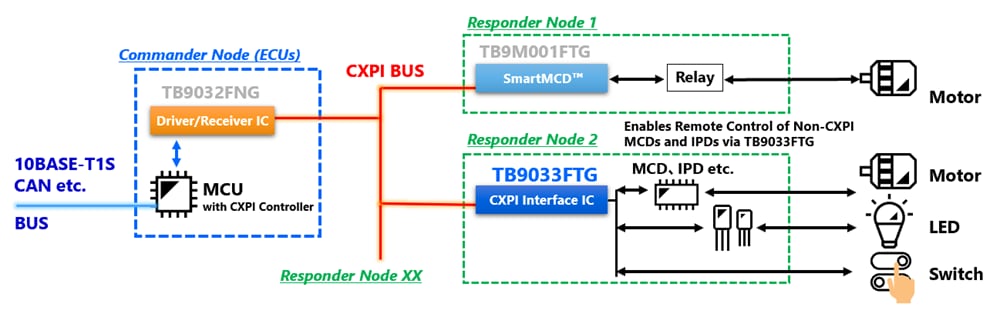
The device integrates CXPI protocol processing and GPIO control functions as hardware logic. This eliminates the need to incorporate a microcontroller or develop new dedicated control software for the responder node, enabling easy connection of existing non-CXPI-compatible motor drivers, intelligent power devices (IPDs), switches, sensors, and LEDs to CXPI networks. It also reduces the burden associated with software development and validation, helping shorten automotive system development time. Furthermore, by reducing component count and development workload, the device helps lower system costs while enabling flexible system configurations tailored to application requirements.
2. Contributes to improved CXPI system development efficiency as the industry’s first product to pass ISO 20794-7 conformance testing
The device is the industry’s first interface IC for automotive CXPI responder nodes to pass conformance testing based on ISO 20794-7 conducted by an independent third-party organization. Its standards compliance enables communication in conformance with the CXPI specification. This helps reduce evaluation and verification workloads during system development and enhance interoperability with other devices, contributing to improved development efficiency of CXPI network systems.
3. Integrates power supply, CXPI communication and various I/O controls into a single chip, supporting a wide range of automotive body applications
In addition to 16 GPIO pins, the product supports A/D inputs, PWM outputs, and switch matrix inputs. It also incorporates a 5V regulator compatible with 12V automotive power supplies and an input monitoring function that operates during sleep mode.
By integrating power supply, CXPI communication and various I/O controls into a single chip, and by combining it with external drivers as required, the device can be applied to a broad range of automotive body applications, including steering wheel switches, operation panels, lighting control and sensor inputs. In addition to enabling design standardization and reducing component count, it provides flexible system configurations tailored to specific application requirements.
Applications
- Body control system applications (steering wheel switches, meter cluster switches, light switches, door locks, door mirror control, etc.)
Main Specifications
| Part number | TB9033FTG | ||
|---|---|---|---|
| Standard | Conforming to CXPI (ISO 20794-2 to 4, ISO 14229-8) of the standard for automotive communications protocols | ||
| Functions | CXPI interface IC with built-in hardware logic (responder node only) | ||
| I/O pins | 16 GPIO pins (4.5 to 5.5V) (Six pins can be configured as inputs to one 10-bit A/D converter, and four pins can be configured as outputs from four 8-bit PWM channels.) |
||
| Input functions |
|
||
| Output functions |
|
||
| Built-in memory | Non-volatile memory (saving I/O pin settings, rewritable) | ||
| Abnormality detection functions | Overheating, overvoltage and undervoltage (The product supports pre-detection of abnormalities and can automatically notify the commander node.) | ||
| Absolute maximum ratings |
Power supply voltage VVBAT (V) | -0.3 to 40 | |
| Electrical characteristics |
VBAT normal operating range VVBAT (V) |
6 to 18 | |
| Current consumption (Dark Current) IVBAT_DSLP (μA) | Typ. | 13 | |
| Operating temperature Ta (°C) |
-40 to 125 | ||
| Communication speed (kbps) | Max | 20 | |
| Package | Name | P-VQFN28-0606-0.65-003 | |
| Size (mm) | 6×6 | ||
| Reliability test | To be AEC-Q100 (Grade 1) qualified | ||
| Sample check & availability |  |
||
Related Contents
Queries about purchasing, sampling and IC reliability
Stock Check & Purchase
require 3 characters or more.
Through this website you are able to proceed to the website of our distributors ("Third Party Website") which is not under the control of Toshiba Corporation and its subsidiaries and affiliates (collectively "Toshiba"). The Third Party Website is made available to you as a convenience only and you agree to use the Third Party Website at your own risk. The link of the Third Party Website does not necessarily imply a recommendation or an endorsement by Toshiba of the Third Party Website. Please be aware that Toshiba is not responsible for any transaction done through the Third Party Website, and such transactions shall be subject to terms and conditions which may be provided in the Third Party Website.
* Company names, product names, and service names may be trademarks of their respective companies.
* Information in this document, including product prices and specifications, content of services and contact information, is current on the date of the announcement but is subject to change without prior notice.