

- General Top
- SEMICONDUCTOR
- STORAGE
- COMPANY
-
My ToshibaSemicon
- Semiconductor Top
-
ApplicationsAutomotive
Body Electronics
xEV
In-Vehicle Infotainment
Advanced Driver-Assistance Systems (ADAS)
Chassis
IndustrialInfrastructure
BEMS/HEMS
Factory Automation
Commercial Equipment
Consumer/PersonalIoT Equipment
Healthcare
Wearable Device
Mobile
Computer Peripherals
-
ProductsAutomotive Devices
Discrete Semiconductor
Diodes
Transistors
Logic ICs
Analog Devices
- Automotive SmartMCD™ (Integreted SoC Conbining Microcontroller and Driver)
- Automotive Brushless Motor Driver ICs
- Automotive Brushed DC Motor Driver ICs
- Automotive Stepping Motor Driver ICs
- Automotive Driver ICs
- Automotive System Power Supplies ICs
- Automotive audio power amplifier ICs
- Automotive Network Communication
Digital Devices
Wireless Devices
※
 : Products list (parametric search)Power Semiconductors
SiC Power Devices
※
: Products list (parametric search)Isolators/Solid State RelaysPhotocouplers
Digital Isolators
Solid State Relays
Fiber Optic Transmitting Modules
※
: Products list (parametric search)MOSFETsIGBTs/IEGTsBipolar Transistors※
: Products list (parametric search)Diodes※
: Products list (parametric search)MicrocontrollersMotor Driver ICsIntelligent Power ICs※
: Products list (parametric search)Power Management ICsLinear ICs※
: Products list (parametric search)General Purpose Logic ICsLinear Image SensorsOther Product ICsOther Product ICs
※
: Products list (parametric search) -
Design & Development
-
Knowledge
Knowledge
- Where To Buy



- Part Number & Keyword Search
- Cross Reference Search
- Parametric Search
- Stock Check & Purchase
This webpage doesn't work with Internet Explorer. Please use the latest version of Google Chrome, Microsoft Edge, Mozilla Firefox or Safari.
require 3 characters or more. Search for multiple part numbers fromhere.
The information presented in this cross reference is based on TOSHIBA's selection criteria and should be treated as a suggestion only. Please carefully review the latest versions of all relevant information on the TOSHIBA products, including without limitation data sheets and validate all operating parameters of the TOSHIBA products to ensure that the suggested TOSHIBA products are truly compatible with your design and application.Please note that this cross reference is based on TOSHIBA's estimate of compatibility with other manufacturers' products, based on other manufacturers' published data, at the time the data was collected.TOSHIBA is not responsible for any incorrect or incomplete information. Information is subject to change at any time without notice.
require 3 characters or more.
Lineup Expansion of Dual-Supply Bus Transceivers and Multiplexers for SPI Interfaces in Server Systems
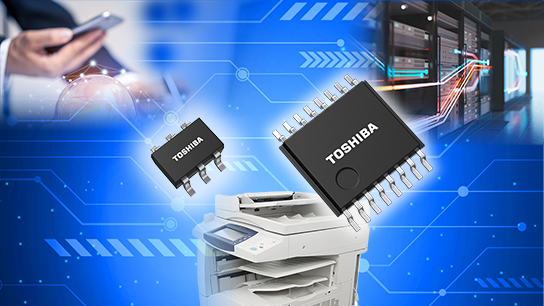
Toshiba Electronic Devices & Storage Corporation ("Toshiba") has launched the "74AVC4T774FT," a 4-bit dual-supply bus transceiver for signal-level translation between different voltage domains, and the "74LVC1G157FU," a one-gate logic IC multiplexer for signal-path switching. The products can be used in the design of circuits handling multiple communication and control signals, including SPI interfaces in servers.
In recent years, advances in AI technology have increased demand for higher performance and lower power consumption in equipment for data centers and edge AI[1] applications. While operating voltages of SoCs[2] used in servers and AI accelerators are being reduced, peripheral devices operate at different voltages, creating a need for level translation between voltage domains.
Server systems also connect a wide variety of devices, including CPUs, GPUs, memory, storage, and networking equipment. In configurations where SPI signals from a BMC[3] are connected to multiple devices, signal-level translation and signal-path switching are required according to the signal direction and destination.
The 74AVC4T774FT enables signal-level translation between different voltage domains while allowing the direction of each signal to be controlled independently. In addition to SPI, it is suitable for level translation of bidirectional or direction-controlled communication and control signals, including UART, GPIO, interrupt and reset signals.
The 74LVC1G157FU selects one of multiple input signals and outputs the selected signal. It can be used to switch the paths of various control signals, including SPI chip-select signals.
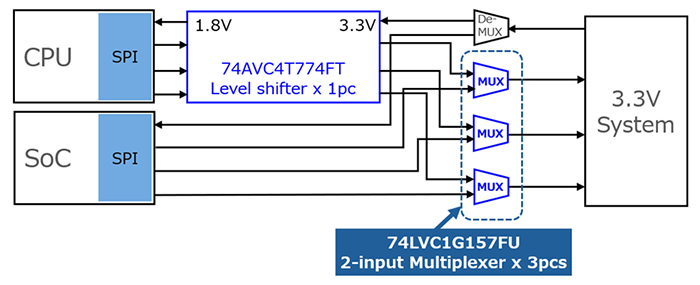
The two products can be used independently or in combination, as required. As shown in Figure 1, combining signal-level translation and signal-path switching allows flexible configuration of interfaces with multiple voltage domains and destinations.
The addition of these products makes it easier to configure signal-level translation and signal-path switching circuits according to application requirements, contributing to improved design efficiency for interface circuits.
Toshiba will continue to expand its lineup of logic products and contribute to improving the efficiency in customers’ system designs.
Notes:
[1] Artificial intelligence technology that processes and analyzes data locally, at the point of generation rather than in the cloud. The "edge" refers to devices located near users or in the field, such as smartphones, sensors, drones, surveillance cameras, and IoT devices.
[2] System on Chip (SoC) is a semiconductor device that integrates multiple functions onto a single chip. Components such as the CPU (processor), memory, and input/output interfaces—which were traditionally implemented as separate ICs—are integrated into a single chip.
[3] Baseboard Management Controller (BMC): A dedicated controller used to monitor and manage server hardware.
[4] Figure 1 shows an example in which the two products are used together. Each product can also be used independently, depending on the application.
Features
74AVC4T774FT
- 1-bit×4 configuration allowing independent direction control of each of the four signals
- Supports VCCA and VCCB from 0.7V to 3.6V, enabling bidirectional level translation
- Industry-standard package (TSSOP16B)
74LVC1G157FU
- 1-bit multiplexer that selects one of two input signals
- Operates from 1.65V to 5.5V and can be used for signal-path switching of SPI and various control signals
- Industry-standard small SOT-363 (US6) package
Features Explanation
74AVC4T774FT
1. 1-bit×4 configuration allowing independent direction control of each of the four signals
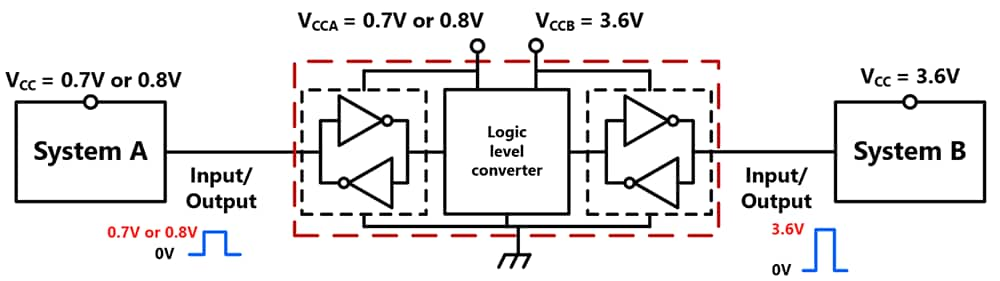
The 74AVC4T774FT has a 1-bit×4 configuration, with an independent direction-control input for each of its four signals.
The existing 74AVC series includes 4-bit products that control signal direction in 2-bit units and 4-bit products with a 3-bit+1-bit configuration suitable for SPI communication. The 74AVC4T774FT is suitable for circuits requiring the direction of four signals to be configured individually.
A single product can provide level translation for multiple communication and control signals, including SPI, GPIO, interrupt and reset signals.
2. Supports VCCA and VCCB from 0.7V to 3.6V, enabling bidirectional level translation
Both VCCA and VCCB can be set within a range of 0.7V to 3.6V. Regardless of the relationship between the two supply voltages, the device supports both up-translation and down-translation. Its push-pull configuration allows it to be used for communication and control signals, including UART, GPIO and SPI.
3. Industry-standard package (TSSOP16B)
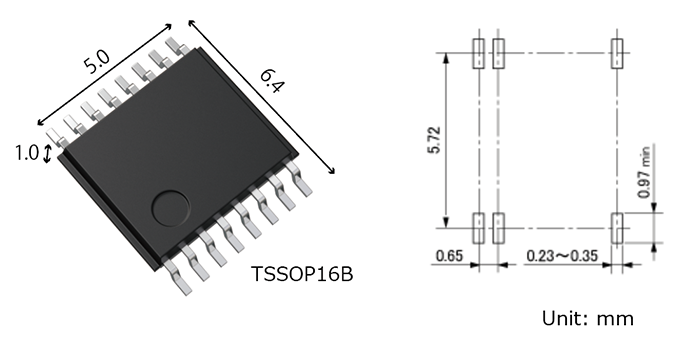
The 74AVC4T774FT is housed in a TSSOP16B package, facilitating its use in existing designs and simplifying component selection.
74LVC1G157FU
1. 1-bit multiplexer that selects one of two input signals
The 74LVC1G157FU is a 1-bit multiplexer that selects one of two input signals and outputs the selected signal. It can be used in circuits that need to select one signal from multiple signals, including SPI chip-select signals and various other control signals.
2. Operates from 1.65V to 5.5V and can be used for signal-path switching of SPI and various control signals
The product operates over a range of 1.65V to 5.5V and supports various voltage systems, including 1.8V, 3.3V and 5V systems.
3. Industry-standard small SOT-363 (US6) package
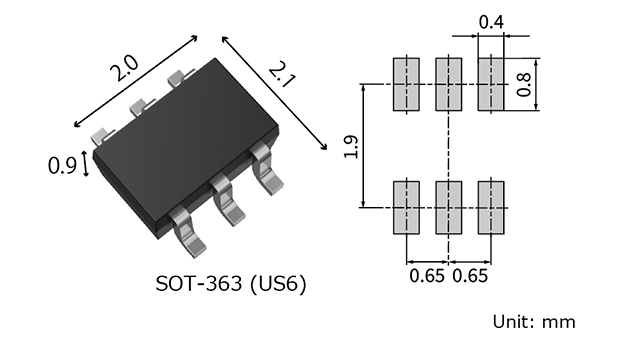
The 74LVC1G157FU is housed in a small SOT-363 (US6) package, making it easy to add signal-switching functionality where required and contributing to circuit miniaturization.
Applications
- Data center servers (SPI communication interfaces)
- Communication equipment, FA equipment, testers, multifunction printers (MFPs), POS terminals, power tools, tablets, laptop PCs, smartphones, audio devices, wearables
Main Specifications
Part number |
74AVC4T774FT | 74LVC1G157FU | ||||
|---|---|---|---|---|---|---|
| Functions | 4-bit dual-supply bus transceiver with configurable power supply | 2-input multiplexer | ||||
Packages |
Name |
SOT-363 (US6) | ||||
Size W×L×H (mm) |
Typ. |
5.0×6.4×1.0 |
2.0×2.1×0.9 | |||
Operating ranges |
Supply voltage VCCA, VCCB (V) |
0.7 to 3.6 |
1.65 to 5.5 | |||
Output current IOUTA, IOUTB, IOUT (mA) |
VCCA, VCCB, VCC =3.0 to 3.6V |
±12 |
±24 | |||
Operating temperature Topr (°C) |
-40 to 125 |
-40 to 125 | ||||
DC Characteristics (Ta=-40 to 85°C) |
High-level input voltage VIHA, VIHB, VIH (V) |
VCCA, VCCB, VCC =3.0 to 3.6V |
Min |
2.0 |
2.0 | |
Low-level input voltage VILA, VILB, VIL (V) |
Max |
0.9 |
0.8 | |||
Quiescent supply current ICCA, ICCB, ICC (μA) |
Max |
8 |
10 | |||
AC Characteristics (Ta=-40 to 85°C) |
Propagation delay time tPLH/tPHL (ns) |
VCCA, VCCB, VCC =3.0 to 3.6V |
Max |
3.7 |
5.8 | |
Sample check & availability |
|
|
||||

Related Contents
How to Level Shift Using One Gate Logic (PDF: 494KB)
Selection Guide 2026 Small Signal and Logic Devices (PDF: 8.7MB)
Stock Check & Purchase
require 3 characters or more.
Through this website you are able to proceed to the website of our distributors ("Third Party Website") which is not under the control of Toshiba Corporation and its subsidiaries and affiliates (collectively "Toshiba"). The Third Party Website is made available to you as a convenience only and you agree to use the Third Party Website at your own risk. The link of the Third Party Website does not necessarily imply a recommendation or an endorsement by Toshiba of the Third Party Website. Please be aware that Toshiba is not responsible for any transaction done through the Third Party Website, and such transactions shall be subject to terms and conditions which may be provided in the Third Party Website.
* Company names, product names, and service names may be trademarks of their respective companies.
* Information in this document, including product prices and specifications, content of services and contact information, is current on the date of the announcement but is subject to change without prior notice.