- General Top
- SEMICONDUCTOR
- STORAGE
- COMPANY
-
My ToshibaSemicon
- Semiconductor Top
-
ApplicationsAutomotive
Body Electronics
xEV
In-Vehicle Infotainment
Advanced Driver-Assistance Systems (ADAS)
Chassis
IndustrialInfrastructure
BEMS/HEMS
Factory Automation
Commercial Equipment
Consumer/PersonalIoT Equipment
Healthcare
Wearable Device
Mobile
Computer Peripherals
-
ProductsAutomotive Devices
Discrete Semiconductor
Diodes
Transistors
Logic ICs
Analog Devices
- Automotive SmartMCD™ (Integreted SoC Conbining Microcontroller and Driver)
- Automotive Brushless Motor Driver ICs
- Automotive Brushed DC Motor Driver ICs
- Automotive Stepping Motor Driver ICs
- Automotive Driver ICs
- Automotive System Power Supplies ICs
- Automotive audio power amplifier ICs
- Automotive Network Communication
Digital Devices
Wireless Devices
※
 : Products list (parametric search)Power Semiconductors
SiC Power Devices
※
: Products list (parametric search)Isolators/Solid State RelaysPhotocouplers
Digital Isolators
Solid State Relays
Fiber Optic Transmitting Modules
※
: Products list (parametric search)MOSFETsIGBTs/IEGTsBipolar Transistors※
: Products list (parametric search)Diodes※
: Products list (parametric search)MicrocontrollersMotor Driver ICsIntelligent Power ICs※
: Products list (parametric search)Power Management ICsLinear ICs※
: Products list (parametric search)General Purpose Logic ICsLinear Image SensorsOther Product ICsOther Product ICs
※
: Products list (parametric search) -
Design & Development
Design & Development
Innovation Centre
At the Toshiba Innovation Centre we constantly strive to inspire you with our technologies and solutions. Discover how to place us at the heart of your innovations.
-
Knowledge
Knowledge
Highlighted Topics
Further Materials
Other
- Where To Buy




- Part Number & Keyword Search
- Cross Reference Search
- Parametric Search
- Stock Check & Purchase
This webpage doesn't work with Internet Explorer. Please use the latest version of Google Chrome, Microsoft Edge, Mozilla Firefox or Safari.
require 3 characters or more. Search for multiple part numbers fromhere.
The information presented in this cross reference is based on TOSHIBA's selection criteria and should be treated as a suggestion only. Please carefully review the latest versions of all relevant information on the TOSHIBA products, including without limitation data sheets and validate all operating parameters of the TOSHIBA products to ensure that the suggested TOSHIBA products are truly compatible with your design and application.Please note that this cross reference is based on TOSHIBA's estimate of compatibility with other manufacturers' products, based on other manufacturers' published data, at the time the data was collected.TOSHIBA is not responsible for any incorrect or incomplete information. Information is subject to change at any time without notice.
require 3 characters or more.
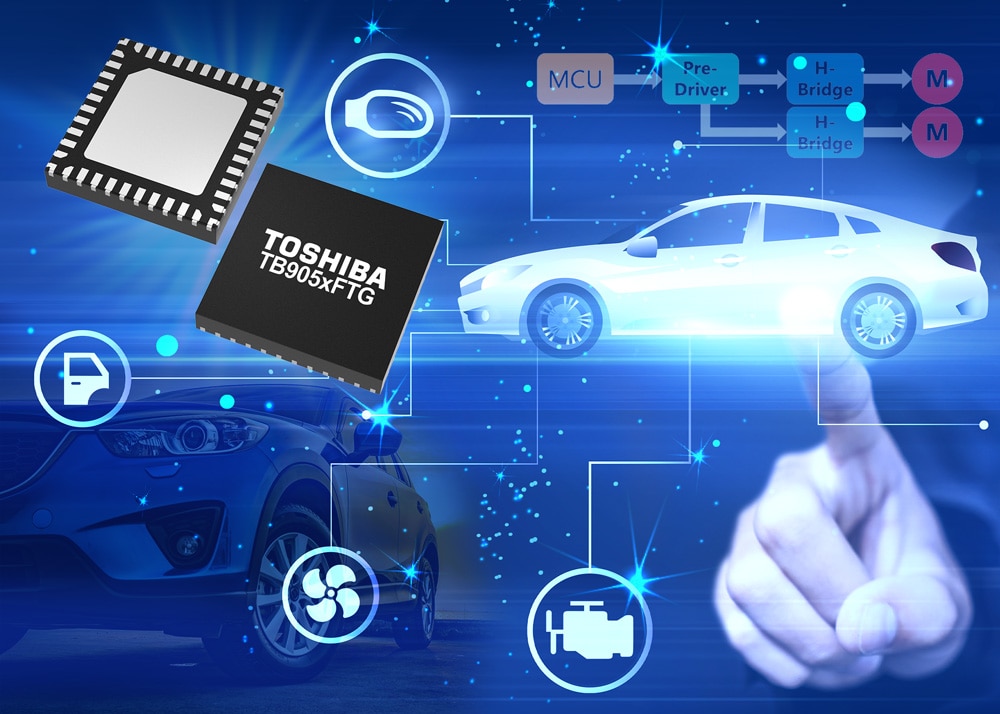
Smart motor control for automotive applications
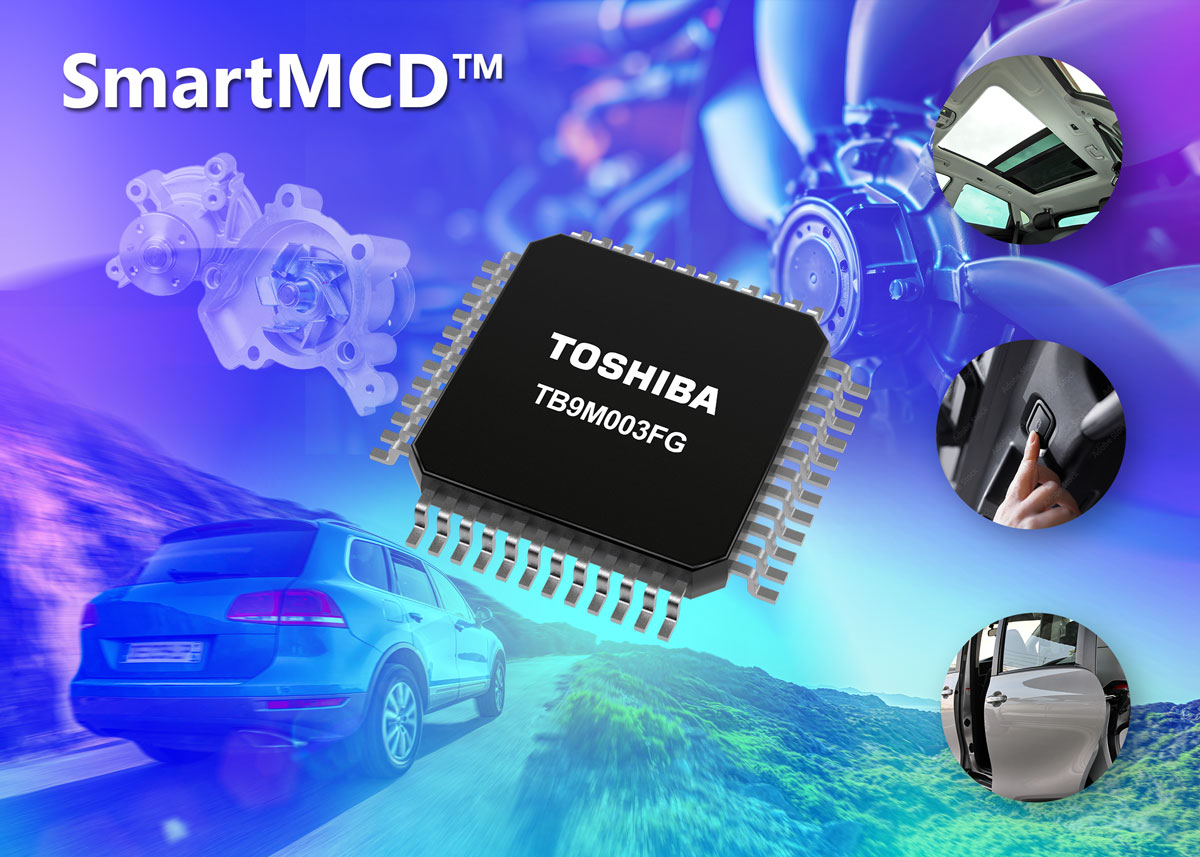
Increasingly, modern automobiles are making use of brushless DC (BLDC) motors in subsystems such as pumps, fans, sunroofs, tailgates, windshield wipers and much more.
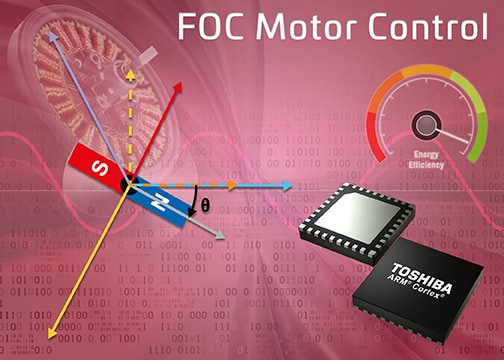
Driving these motors is easy, but to drive them in an optimal way is far more challenging. Approaches such as vector or Field-Oriented Control (FOC) deliver smooth operation over a wide speed range but they require a significant amount of microcontroller (MCU) capacity to operate.
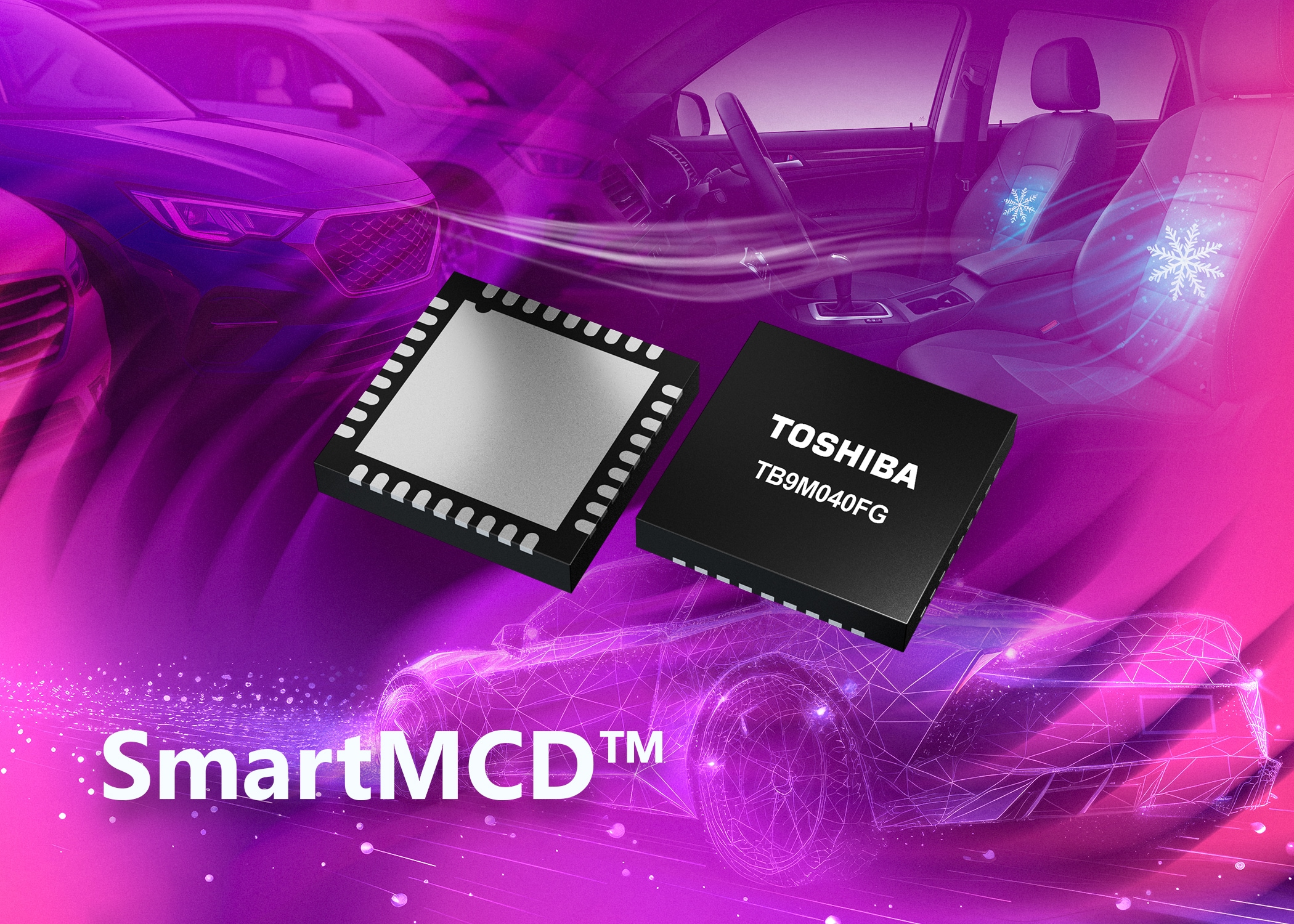
Increasingly, designers are taking the task of controlling the BLDC motor away from the MCU and implementing a dedicated motor control driver, such as Toshiba’s TB9M003FG SmartMCDä.
This comprehensive solution is based upon Toshiba’s advanced mixed-signal process and utilises an ArmÒ CortexÒ CPU running at 40MHz with a high-performance hardware vector engine co-processor to achieve FOC cycle times below 30 µsec and gate drivers to control external B6 N-channel MOSFETs. The highly integrated system-on-chip (SoC) has several functional blocks to provide a single-chip complete control system for single-shunt BLDC motor operation.
At the heart of the system is the vector engine (A-VEa) that supports a number of transformations as well as PI for current control. The vector engine drives the programmable motor driver (PMD) that generates PWM various carrier signals with individual waveforms possible for each phase. Three optional Hall sensor inputs are available for rotor position sensing of the BLDC motor.
Also integrated into the TB9M003FG is a six-channel gate driver with slew rate control to control external MOSFETs. This block is capable of detecting open- and short-circuit MOSFETs, ensuring system robustness. The twelve GPIO lines are able to be multiplexed with other interfaces to provide a variety of communication interfaces, including LIN, UART2 and SPI.
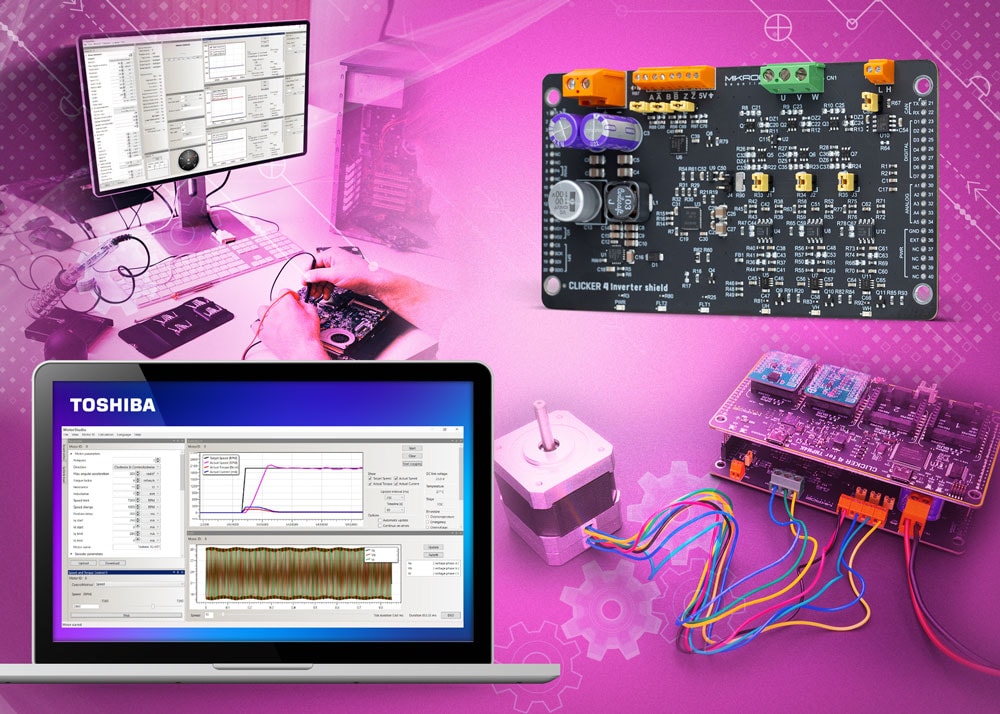
To assist designers, Toshiba has developed a SmartMCD evaluation kit developed around a microcontroller development kit and the TB9M003FG evaluation board, along with four varieties of inverter boards featuring automotive-grade power N-channel MOSFETs from Toshiba.
The evaluation kit is complemented by ‘Motor Studio’, an easy-to-use and versatile PC tool that logs multiple parameters and allows easy system evaluation and debugging.