- General Top
- SEMICONDUCTOR
- STORAGE
- COMPANY
-
My ToshibaSemicon
- Semiconductor Top
-
ApplicationsAutomotive
Body Electronics
xEV
In-Vehicle Infotainment
Advanced Driver-Assistance Systems (ADAS)
Chassis
IndustrialInfrastructure
BEMS/HEMS
Factory Automation
Commercial Equipment
Consumer/PersonalIoT Equipment
Healthcare
Wearable Device
Mobile
Computer Peripherals
-
ProductsAutomotive Devices
Discrete Semiconductor
Diodes
Transistors
Logic ICs
Analog Devices
- Automotive SmartMCD™ (Integreted SoC Conbining Microcontroller and Driver)
- Automotive Brushless Motor Driver ICs
- Automotive Brushed DC Motor Driver ICs
- Automotive Stepping Motor Driver ICs
- Automotive Driver ICs
- Automotive System Power Supplies ICs
- Automotive audio power amplifier ICs
- Automotive Network Communication
Digital Devices
Wireless Devices
※
 : Products list (parametric search)Power Semiconductors
SiC Power Devices
※
: Products list (parametric search)Isolators/Solid State RelaysPhotocouplers
Digital Isolators
Solid State Relays
Fiber Optic Transmitting Modules
※
: Products list (parametric search)MOSFETsIGBTs/IEGTsBipolar Transistors※
: Products list (parametric search)Diodes※
: Products list (parametric search)MicrocontrollersMotor Driver ICsIntelligent Power ICs※
: Products list (parametric search)Power Management ICsLinear ICs※
: Products list (parametric search)General Purpose Logic ICsLinear Image SensorsOther Product ICsOther Product ICs
※
: Products list (parametric search) -
Design & Development
Design & Development
Innovation Centre
At the Toshiba Innovation Centre we constantly strive to inspire you with our technologies and solutions. Discover how to place us at the heart of your innovations.
-
Knowledge
Knowledge
Highlighted Topics
Further Materials
Other
- Where To Buy




- Part Number & Keyword Search
- Cross Reference Search
- Parametric Search
- Stock Check & Purchase
This webpage doesn't work with Internet Explorer. Please use the latest version of Google Chrome, Microsoft Edge, Mozilla Firefox or Safari.
require 3 characters or more. Search for multiple part numbers fromhere.
The information presented in this cross reference is based on TOSHIBA's selection criteria and should be treated as a suggestion only. Please carefully review the latest versions of all relevant information on the TOSHIBA products, including without limitation data sheets and validate all operating parameters of the TOSHIBA products to ensure that the suggested TOSHIBA products are truly compatible with your design and application.Please note that this cross reference is based on TOSHIBA's estimate of compatibility with other manufacturers' products, based on other manufacturers' published data, at the time the data was collected.TOSHIBA is not responsible for any incorrect or incomplete information. Information is subject to change at any time without notice.
require 3 characters or more.
Why automotive motor control should scale without changing architecture
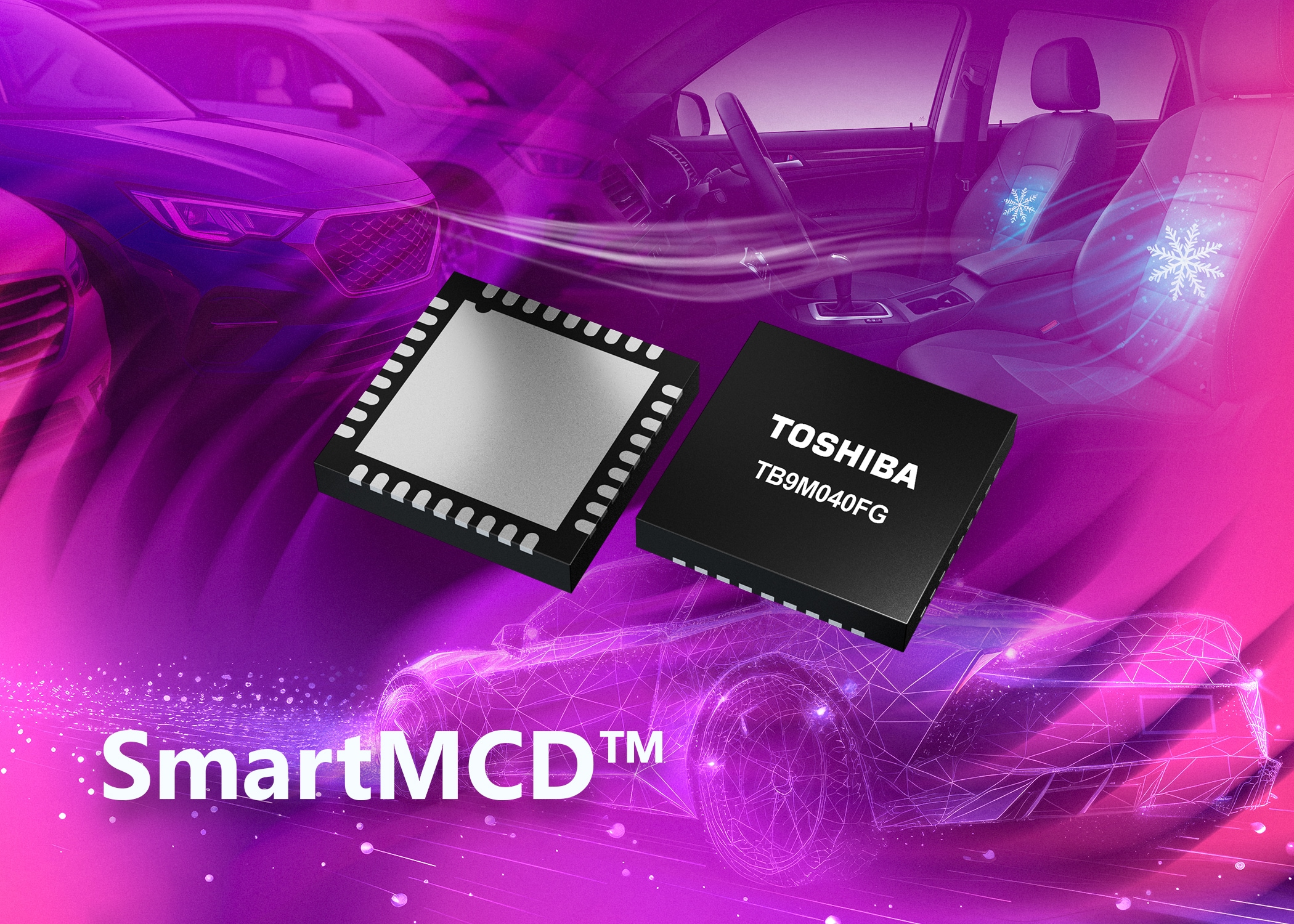
Today’s cars contain dozens of electric motors, but they do not all share the same power requirements. A seat adjustment motor, cooling fan, valve actuator and thermal-management pump may differ significantly in output power, mechanical load and board-space constraints. Even so, many of the control requirements remain familiar: PWM generation, current measurement, position estimation or sensing, communication and fault handling.
Changing the control architecture for every motor application increases software effort, validation workload and development risk. A more scalable approach is to keep the motor-control architecture consistent, while matching the level of integration to the application.
For compact brushless DC (BLDC) motor designs up to around 40W, Toshiba’s latest addition to the SmartMCD™ family, the TB9M040FTG, integrates an on-chip three-phase 2A bridge driver. This reduces the need for an external inverter stage and can help lower component count in space-constrained designs.
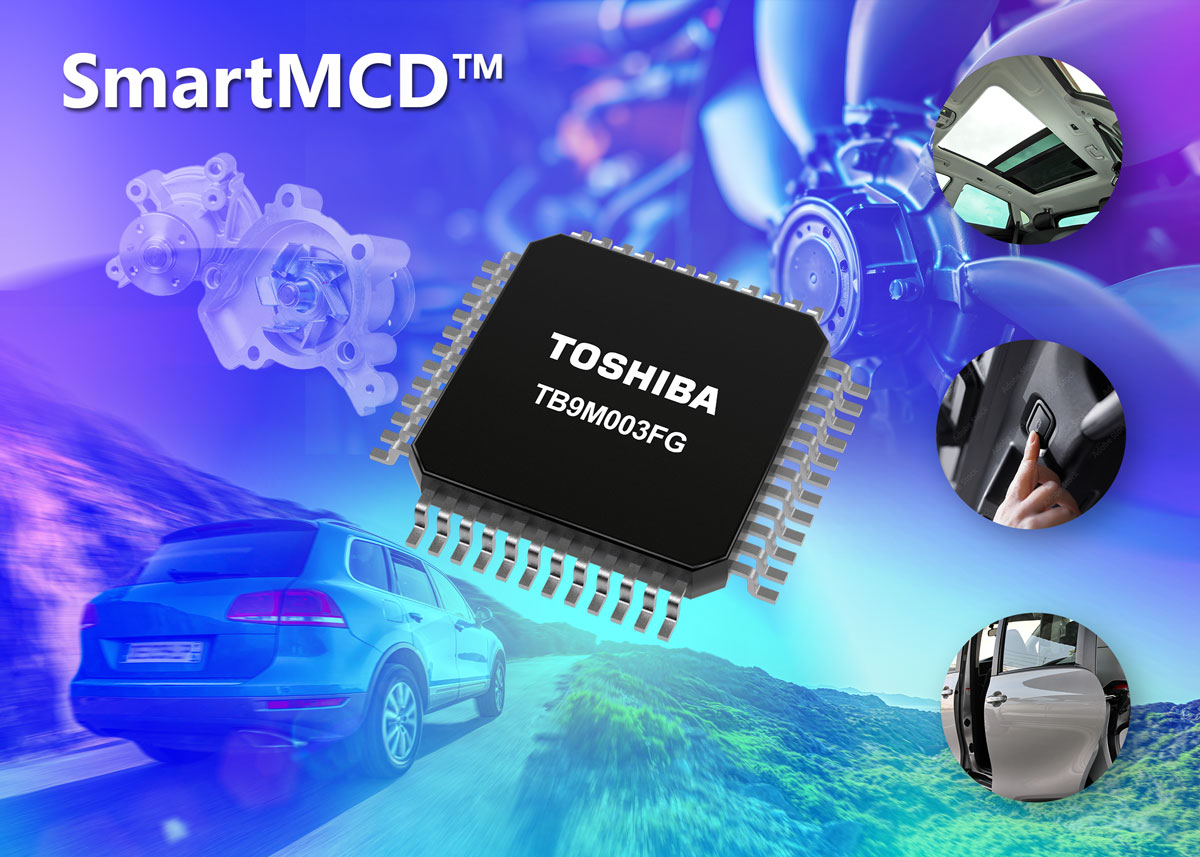
For higher-power applications, Toshiba’s TB9M003/030FG SmartMCD™ devices integrate three-phase MOSFET pre-drivers, allowing engineers to use external power devices for motor designs in the 40W to 1,000W range.
The distinction is important. Lower-power applications can benefit from the board-space and BOM advantages of an integrated bridge driver. Higher-power applications can retain the flexibility of an external MOSFET stage. The development approach, however, remains aligned around the same SmartMCD™ family concept.
That consistency matters when engineering teams are working across multiple vehicle functions. Experience gained on one motor-control design can carry over to the next, rather than being tied to a single device or power class.
The TB9M040FTG also supports different sensing strategies. Sensorless field-oriented control (FOC) is supported through Toshiba’s A-VEα vector engine, while applications requiring direct rotor position feedback can use Hall sensors or incremental encoders. The device also supports zero-crossing detection for BLDC motors using square-wave commutation. This flexibility allows addressing different application priorities, from low acoustic noise and smooth torque control to simpler commutation methods where appropriate.
Software structure reinforces the same idea. Toshiba’s support package separates low-level peripheral drivers from higher-layer motor-control drivers, helping engineers evaluate and implement BLDC motor control without treating each project as a completely separate software environment.
Download the whitepaper to learn how Toshiba’s new TB9M040FTG SmartMCD™, suited to cost-optimised, space-restricted applications in the sub-40W power range, enables a scalable approach to automotive BLDC motor control, allowing engineers to apply a common development environment and motor-control architecture across applications.