- General Top
- SEMICONDUCTOR
- STORAGE
- COMPANY
-
My ToshibaSemicon
- Semiconductor Top
-
ApplicationsAutomotive
Body Electronics
xEV
In-Vehicle Infotainment
Advanced Driver-Assistance Systems (ADAS)
Chassis
IndustrialInfrastructure
BEMS/HEMS
Factory Automation
Commercial Equipment
Consumer/PersonalIoT Equipment
Healthcare
Wearable Device
Mobile
Computer Peripherals
-
ProductsAutomotive Devices
Discrete Semiconductor
Diodes
Transistors
Logic ICs
Analog Devices
- Automotive SmartMCD™ (Integreted SoC Conbining Microcontroller and Driver)
- Automotive Brushless Motor Driver ICs
- Automotive Brushed DC Motor Driver ICs
- Automotive Stepping Motor Driver ICs
- Automotive Driver ICs
- Automotive System Power Supplies ICs
- Automotive audio power amplifier ICs
- Automotive Network Communication
Digital Devices
Wireless Devices
※
 : Products list (parametric search)Power Semiconductors
SiC Power Devices
※
: Products list (parametric search)Isolators/Solid State RelaysPhotocouplers
Digital Isolators
Solid State Relays
Fiber Optic Transmitting Modules
※
: Products list (parametric search)MOSFETsIGBTs/IEGTsBipolar Transistors※
: Products list (parametric search)Diodes※
: Products list (parametric search)MicrocontrollersMotor Driver ICsIntelligent Power ICs※
: Products list (parametric search)Power Management ICsLinear ICs※
: Products list (parametric search)General Purpose Logic ICsLinear Image SensorsOther Product ICsOther Product ICs
※
: Products list (parametric search) -
Design & Development
Design & Development
Innovation Centre
At the Toshiba Innovation Centre we constantly strive to inspire you with our technologies and solutions. Discover how to place us at the heart of your innovations.
-
Knowledge
Knowledge
Highlighted Topics
Further Materials
Other
- Where To Buy




- Part Number & Keyword Search
- Cross Reference Search
- Parametric Search
- Stock Check & Purchase
This webpage doesn't work with Internet Explorer. Please use the latest version of Google Chrome, Microsoft Edge, Mozilla Firefox or Safari.
require 3 characters or more. Search for multiple part numbers fromhere.
The information presented in this cross reference is based on TOSHIBA's selection criteria and should be treated as a suggestion only. Please carefully review the latest versions of all relevant information on the TOSHIBA products, including without limitation data sheets and validate all operating parameters of the TOSHIBA products to ensure that the suggested TOSHIBA products are truly compatible with your design and application.Please note that this cross reference is based on TOSHIBA's estimate of compatibility with other manufacturers' products, based on other manufacturers' published data, at the time the data was collected.TOSHIBA is not responsible for any incorrect or incomplete information. Information is subject to change at any time without notice.
require 3 characters or more.
Why finer microstepping does not always mean quieter motion
Conventional microstepping generates the phase-current waveform from a finite number of current levels. Increasing the number of microsteps brings that waveform closer to the ideal sinusoidal profile, but small errors remain between the generated and ideal currents.
These errors produce periodic variations in motor torque. Couplings, gears, belts, lead screws and supporting structures all have natural resonant frequencies, and torque ripple at or near one of these frequencies can increase vibration in the motor and driven load. The vibration can then pass through the mechanical assembly and be radiated as audible noise.
In a surveillance camera, both effects can become visible at system level. The positioning mechanism has to move accurately without introducing vibration or objectionable motor noise. Current waveform accuracy therefore has a direct bearing on the mechanical and acoustic behaviour of the assembly.
Key takeaways:
- Discrete microstep currents remain an approximation of a sinusoidal waveform.
- Waveform error creates torque ripple that can excite resonances in the motor and driven mechanism.
- Mechanical damping can suppress vibration after it has been generated, but may add components, mass or design constraints.
- Smoother phase-current generation reduces the disturbance before the mechanical system can amplify it.
Torque ripple can excite the mechanics
An ideal pair of sinusoidal phase currents produces a uniform rotating magnetic field and smooth torque. A conventional microstepping driver generates those currents from a finite number of levels.
Small differences between the generated and ideal waveforms create corresponding variations in motor torque.
The frequency content of those variations matters. A camera mechanism contains its own resonant frequencies, determined by the motor, transmission, mounting structure and load. When a torque-ripple component approaches one of those frequencies, the mechanical response can amplify the original disturbance.
Audible motor noise can therefore originate in the electrical drive waveform even when the mechanism itself is functioning correctly.
Mechanical damping can add size and weight
Damping materials, vibration isolation, flexible couplings and structural reinforcement can limit the transmission of vibration through the mechanism. Operating conditions can also be selected to avoid known resonant regions.
Mechanical damping may increase system size, weight or cost, but avoiding resonant regions can restrict the available speed range. Current waveform accuracy provides another design variable: lower torque ripple reduces the vibration available to excite the motor, load and supporting structure.
A smoother current waveform reduces the excitation
Continuous microstepping adjusts phase current continuously rather than constructing the waveform from discrete current levels. The closer sinusoidal current profile produces smoother torque and reduces the energy available to excite mechanical resonances.
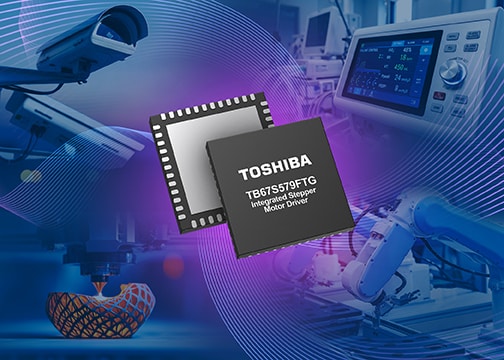
Toshiba’s TB67S579FTG is one implementation of this approach. Its continuous microstepping function sits within a two-phase bipolar stepper motor driver intended for precision motion-control applications.
Follow the path from current waveform to acoustic noise
The whitepaper Advanced Microstepping Technology for Precise Stepper Motor Control examines how current waveform approximation becomes torque ripple, how the mechanical system can amplify it, and how continuous microstepping changes that relationship.
It also considers the broader design trade-offs involved in achieving smoother motion without adding excessive mechanical or control complexity.