

- General Top
- SEMICONDUCTOR
- STORAGE
- COMPANY
-
My ToshibaSemicon
- Semiconductor Top
-
ApplicationsAutomotive
Body Electronics
xEV
In-Vehicle Infotainment
Advanced Driver-Assistance Systems (ADAS)
Chassis
IndustrialInfrastructure
BEMS/HEMS
Factory Automation
Commercial Equipment
Consumer/PersonalIoT Equipment
Healthcare
Wearable Device
Mobile
Computer Peripherals
-
ProductsAutomotive Devices
Discrete Semiconductor
Diodes
Transistors
Logic ICs
Analog Devices
- Automotive SmartMCD™ (Integreted SoC Conbining Microcontroller and Driver)
- Automotive Brushless Motor Driver ICs
- Automotive Brushed DC Motor Driver ICs
- Automotive Stepping Motor Driver ICs
- Automotive Driver ICs
- Automotive System Power Supplies ICs
- Automotive audio power amplifier ICs
- Automotive Network Communication
Digital Devices
Wireless Devices
※
 : Products list (parametric search)Power Semiconductors
SiC Power Devices
※
: Products list (parametric search)Isolators/Solid State RelaysPhotocouplers
Digital Isolators
Solid State Relays
Fiber Optic Transmitting Modules
※
: Products list (parametric search)MOSFETsIGBTs/IEGTsBipolar Transistors※
: Products list (parametric search)Diodes※
: Products list (parametric search)MicrocontrollersMotor Driver ICsIntelligent Power ICs※
: Products list (parametric search)Power Management ICsLinear ICs※
: Products list (parametric search)General Purpose Logic ICsLinear Image SensorsOther Product ICsOther Product ICs
※
: Products list (parametric search) -
Design & Development
-
Knowledge
- Where To Buy



- Part Number & Keyword Search
- Cross Reference Search
- Parametric Search
- Stock Check & Purchase
This webpage doesn't work with Internet Explorer. Please use the latest version of Google Chrome, Microsoft Edge, Mozilla Firefox or Safari.
require 3 characters or more. Search for multiple part numbers fromhere.
The information presented in this cross reference is based on TOSHIBA's selection criteria and should be treated as a suggestion only. Please carefully review the latest versions of all relevant information on the TOSHIBA products, including without limitation data sheets and validate all operating parameters of the TOSHIBA products to ensure that the suggested TOSHIBA products are truly compatible with your design and application.Please note that this cross reference is based on TOSHIBA's estimate of compatibility with other manufacturers' products, based on other manufacturers' published data, at the time the data was collected.TOSHIBA is not responsible for any incorrect or incomplete information. Information is subject to change at any time without notice.
require 3 characters or more.
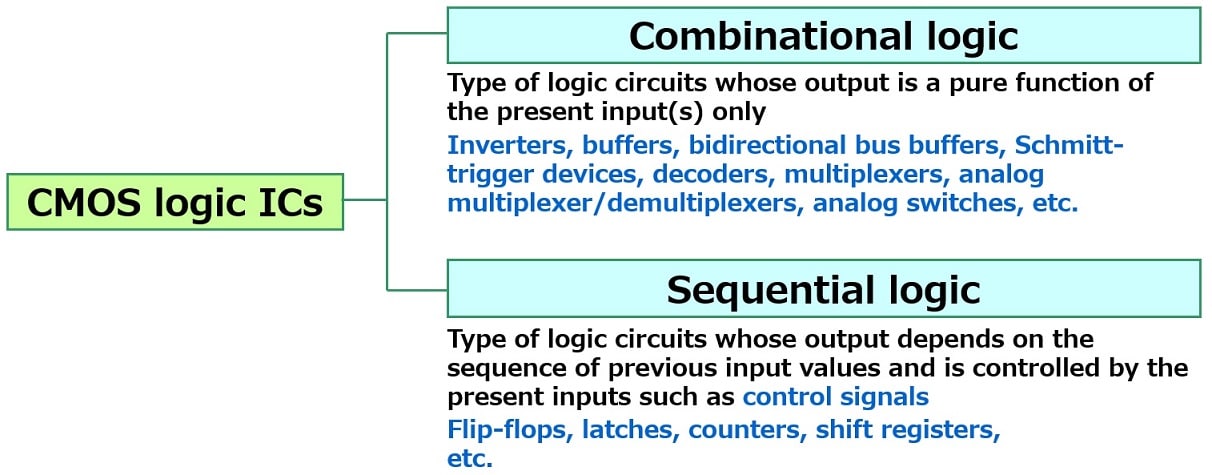
3-2-2. Combinational Logic: Bidirectional Bus Buffers

Bidirectional bus buffers (transceivers)
Example: 74VHC245
A bidirectional bus buffer (transceiver) is a type of logic circuit whose I/O pins can be configured as input and output to receive and transmit data.
Since a transceiver allows the signal direction to be changed via a control signal (DIR), it is used along a bus line through which data are transferred bidirectionally.
The following shows an example of application of a transceiver.
When using bus signals bi-directionally, connect both the bus input and bus output to VCC or GND via a pull-up resistor to prevent the input signal from becoming open (undefined) when the signal is switched by the control signal (DIR).
Please be careful not to short-circuit the output with the output of the bus line when switching signals.
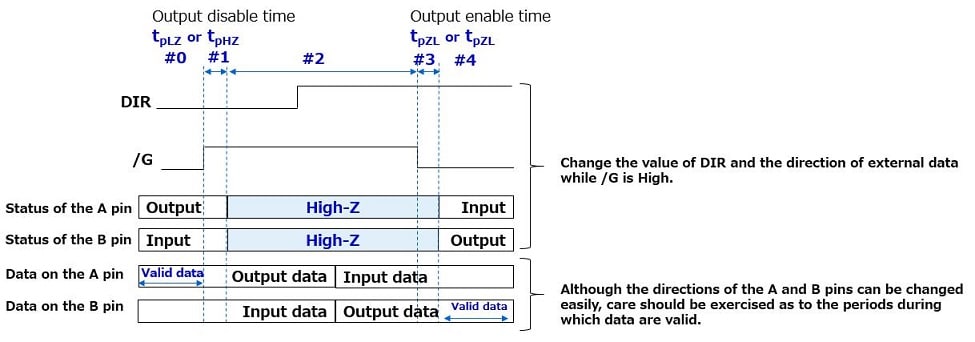
The direction of the A and B pins can be changed easily by changing the value of DIR while /G is High.
Change the value of DIR and the direction of external data while /G is High.
During period #0, data are transferred from B to A.
During period #1, the A pin assumes the High-Z state. Therefore, output data are invalid.
During period #2, change the value of DIR and the direction of external data.
During period #3, enable the A and B pins. Then, output data stabilize at the beginning of period #4.
During period #4, data are transferred from A to B.
Chapter3 Basic CMOS Logic ICs

Products
Related information
- Application Notes
- FAQ